Grey Tree Frog
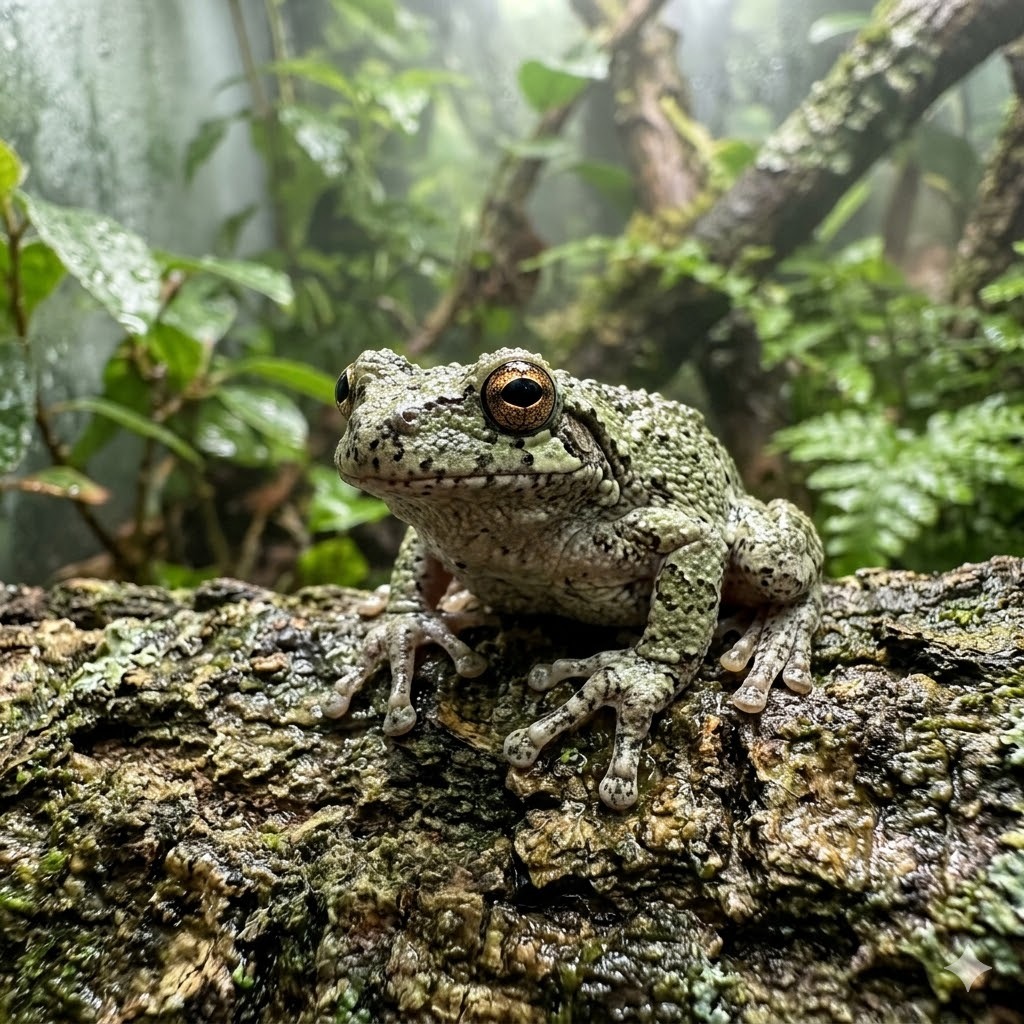
The Grey Tree Frog (Dryophytes versicolor) is a small, warty-skinned arboreal frog from eastern North America whose greatest trick is written into its name - versicolor, "many colours." It can shift from bright green to ashy grey, brown, or nearly white to match its perch, all within minutes.
🗓️ Last reviewed: July 2026
Overview
The Grey Tree Frog (Dryophytes versicolor) is a small, warty-skinned arboreal frog from eastern North America whose greatest trick is written into its name - versicolor, "many colours." It can shift from bright green to ashy grey, brown, or nearly white to match its perch, all within minutes. Cold-tolerant and hardy, it produces a loud, musical trill on warm evenings that carries far across woodland. As a pet it is an ideal look-don't-touch display frog: undemanding in temperature compared with tropical species, long-lived for its size, and a master of camouflage that keepers love to watch shift shade against bark and leaf.
Natural History
Dryophytes versicolor (formerly Hyla versicolor) ranges widely across eastern North America, from southern Canada down through the eastern United States. It lives in deciduous and mixed woodland, orchards, and wooded backyards, spending most of the year high in trees and only descending to breed in shallow ponds and pools in spring and summer.
It is remarkably cold-hardy - wild grey tree frogs survive freezing winters by producing glycerol and glucose as natural antifreeze, tolerating partial freezing of their body fluids and thawing out unharmed in spring. Breeding males trill loudly on warm, humid nights, gathering at shallow ponds where females lay clumps of eggs attached to vegetation; tadpoles transform over one to two months. Because it copes with cold so well, this frog is far less dependent on heating equipment than tropical species, one reason it suits many temperate homes. The species is common and readily captive-bred; as always, buy captive-bred stock rather than collecting or buying wild-caught frogs, which stress badly, carry parasites, and can introduce disease into a collection.
Appearance
Adults reach roughly 3-6 cm (1.25-2.5 inches) snout to vent, with females a little larger. They are compact and weigh only a few grams.
The skin is noticeably bumpy and warty compared with the smooth green tree frog. Colour is highly variable and changeable - green, grey, brown, or mottled - often with a darker star-shaped or blotchy pattern on the back. A pale patch usually sits beneath each eye. The hidden surfaces of the hind legs flash bright orange-yellow, startling to a predator when the frog leaps. Large sticky toe pads grip bark and glass. The near-identical Cope's grey tree frog (Dryophytes chrysoscelis) is told apart mainly by a faster call.
Temperament & Handling
Quiet and cryptic by day, active and vocal by night. This is a display animal, not a handling pet. Its permeable skin absorbs oils, salts, soaps, and residues, so look, don't handle. If a frog must be moved, wet clean hands with dechlorinated water first, handle briefly, and never with any product on your skin. Expect loud, pleasant trilling from males on warm evenings and before rain - a woodland sound many keepers enjoy, but worth knowing about if you sleep nearby.
Enclosure
Minimum: a tall 45 x 45 x 60 cm (roughly 18 x 18 x 24 inch) vertical vivarium for one to three adults; height matters more than floor space for these climbers.
Provide:
- Vertical branches, cork bark, and broad-leaved live or silk plants for climbing and hiding.
- A shallow, spotless water dish of dechlorinated water.
- A moisture-retaining substrate such as coco fibre or a bioactive mix, damp but not waterlogged.
- Leaf litter and bark hides at several heights, which suit their camouflage instincts.
- A secure fine-mesh or glass top; they climb glass easily and escape gaps.
Similar-sized frogs can share a well-planted enclosure.
Heating, Lighting, Humidity
- Temperature: comfortable at 20-26°C by day with a cooler night drop; being a temperate species, it tolerates - and benefits from - a natural seasonal cooling and does not need tropical warmth. Avoid sustained heat above the high twenties.
- Humidity: 50-70%, maintained by daily misting with dechlorinated water, allowing slight drying between mistings.
- Lighting: a low-level UVB bulb is beneficial, and full-spectrum light on a 12-hour cycle supports live plants. Keep out of direct sun.
Diet
Insectivore.
- Appropriately sized crickets as a staple.
- Flightless fruit flies, small roaches, and moths.
- Occasional waxworms or silkworms as a fatty treat.
Dust feeders with calcium and vitamin D3 several times a week and a multivitamin about weekly. Prey should be no wider than the gap between the eyes to prevent choking or impaction. Adults eat every two to three days, growing juveniles daily. Feeding after dark matches their nocturnal habits, and watching a grey tree frog stalk and snatch a moth is one of the pleasures of keeping them. Remove uneaten insects promptly so they cannot harass a resting frog.
Health & Lifespan
Typically 7-9 years in captivity, sometimes reaching the low teens with excellent care.
Common concerns:
- Metabolic bone disease from insufficient calcium or UVB.
- Chytrid and other skin infections - quarantine new arrivals; buy captive-bred.
- Bacterial "red leg" from poor hygiene or dirty water.
- Chemical poisoning - very sensitive to chlorine, chloramine, soaps, and aerosols. Use dechlorinated water and keep sprays, scented candles, and cleaning products away from the tank.
- Obesity from over-rich feeders such as too many waxworms.
- Dehydration if humidity drops too low or the water dish runs dry.
Line up an amphibian-experienced exotics vet in advance.
Pros & Cons
Pros:
- Astonishing colour-changing camouflage to watch.
- Hardy and cold-tolerant - forgiving of cooler homes.
- Long-lived for a small frog.
- Attractive musical trill.
Cons:
- Cannot be handled.
- Males trill loudly at night.
- Requires live insect feeders.
- Sensitive to water quality and airborne chemicals.
Best Suited For
- Keepers who like watching behaviour and camouflage change.
- Homes on the cooler side that struggle to keep tropical species warm.
- Older children and adults comfortable with a look-don't-touch pet.
Not suited for anyone wanting a handleable frog, very light sleepers, or homes where aerosol sprays are used near the enclosure.
Grey Tree Frog - frequently asked questions
Why does my frog keep changing colour?
That is its signature ability, reflected in the name versicolor. Grey tree frogs shift between green, grey, and brown in response to temperature, light, humidity, and background to stay camouflaged, sometimes changing shade within minutes. It is completely normal and healthy, not a sign of stress on its own.
Are they hard to keep warm?
No - the opposite. As a temperate species they do fine at ordinary room temperatures and tolerate cooler nights, so they are easier than tropical frogs for many homes.
What is the bright colour on their legs?
The hidden inner thighs flash orange-yellow when the frog jumps, startling predators. You will glimpse it during leaps.
Can I keep more than one?
Yes, if they are a similar size and well fed, in a spacious planted vivarium.
How long do they live?
Usually 7-9 years, and sometimes into the low teens with top care.
🧠 Test yourself: guess the amphibian
Three clues from our quiz bank, each about another of our amphibians. Can you name them?
Clue 1.A popular beginner amphibian, this little green-and-black hopper spends much of its time floating in shallow water.
It's the Fire-Bellied Toad - read the full profile →
Clue 2.Famous for its permanent smile and frilly pink gill stalks, this underwater creature is a popular exotic pet and a marvel of regeneration.
It's the Axolotl - read the full profile →
Clue 3.This tiny fully aquatic amphibian spends its whole life underwater, surfacing only to gulp air, and is a popular tank companion for small fish.
It's the African Dwarf Frog - read the full profile →