Peterbald (Felis catus)
The Peterbald is an elegant, slender, fine-boned cat from Russia, best known for its hairlessness, though in fact the breed comes in a remarkable range of coats from completely bald to a short "brush" coat.
🗓️ Last reviewed: June 2026
Overview
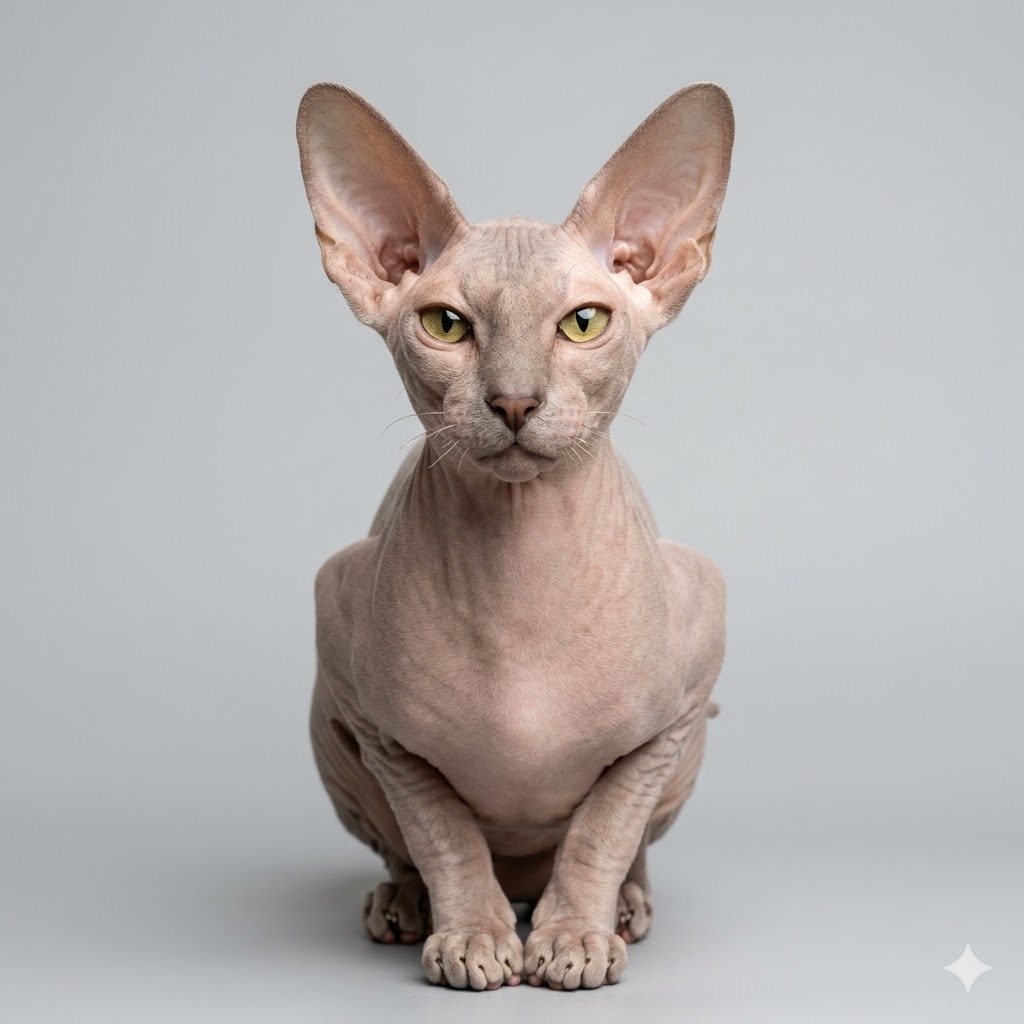
The Peterbald is an elegant, slender, fine-boned cat from Russia, best known for its hairlessness, though in fact the breed comes in a remarkable range of coats from completely bald to a short "brush" coat. Graceful and aristocratic in build, with a long whippy body, almond eyes, and enormous flared ears, the Peterbald combines a striking, exotic appearance with an exceptionally affectionate, sociable, and people-loving personality. It is a true companion cat that wants to be involved in everything its family does.
History & Origins
The Peterbald is a young Russian breed, created in 1994 in St. Petersburg by breeder Olga S. Mironova. The foundation cross paired a Don Sphynx (Donskoy), a hairless breed carrying a dominant hairlessness gene, with an Oriental Shorthair. The goal was to combine the Don Sphynx's hairlessness with the refined, elegant body type of the Oriental.
The name reflects this heritage: "Peter" for St. Petersburg, where the breed began, and "bald" for its signature lack of coat. The first litters produced the elegant, fine-boned hairless cats that define the breed today.
Unlike the Sphynx, whose hairlessness comes from a recessive gene, the Peterbald's hairlessness derives from the dominant gene inherited from the Don Sphynx. This produces the breed's distinctive range of coat types. The Peterbald was accepted by TICA, gaining championship status in the mid-2000s, and continues to be developed with Oriental and Siamese outcrosses to preserve health and refine type. It remains relatively uncommon outside Russia.
Appearance
Medium-sized, long, slender, and elegant with fine bone and firm muscle - the classic Oriental-derived body in a hairless cat. Males weigh 3.5-5 kg (8-11 lb); females 3-4 kg (6-9 lb).
Key features:
- Coat: the breed's most variable trait, ranging across several types - "bald" (completely hairless, with warm, soft skin like a peach), "flock" or "chamois" (an almost invisible fuzz), "velour" (a short soft coat), "brush" (a wiry coarse coat), and "straight" (a normal short coat in cats that did not inherit the hairless gene).
- Skin: on hairless cats, warm and soft to the touch, often wrinkled around the muzzle, between the ears, and on the neck. Skin colour and any markings reflect the underlying coat pattern.
- Colour: comes in essentially all colours and patterns, including the pointed colours inherited from its Oriental and Siamese background.
- Head: a long, narrow, inverted-triangle wedge with a straight profile and a strong, fine muzzle.
- Eyes: medium-sized, almond-shaped, and slanted, often a vivid green or blue.
- Ears: very large, wide at the base, and set to continue the lines of the wedge - one of the breed's most dramatic features.
- Body: long, slender, and elegant with a whippy tail and notably long, slim legs and webbed, dexterous paws that the cat uses with near-prehensile skill.
Temperament & Character
The Peterbald is intensely affectionate, sociable, and devoted - one of the most people-oriented of all breeds. It bonds deeply with its family, craves attention, and wants to be involved in everything, following its owners from room to room and greeting visitors enthusiastically.
This is an active, intelligent, and curious cat with a playful, energetic streak inherited from its Oriental ancestry. Peterbalds are talkative, communicating in a soft voice, and they use their dexterous, webbed paws to manipulate toys and objects with remarkable skill.
The breed thrives on companionship and does not cope well with being left alone for long. Peterbalds are warmth-seeking cats - their lack of coat means they love to snuggle under blankets, share laps, and burrow against their people for heat.
Friendly and adaptable, the Peterbald generally gets on well with children, other cats, and cat-friendly dogs, and it tends to suit busy, sociable households where there is plenty of interaction and warmth to go around.
Care
Coat & Grooming
Care depends entirely on coat type, but hairless Peterbalds need specific skin care. Without a coat to absorb oils, the skin produces a waxy residue that must be removed by regular gentle wiping with a damp cloth or a weekly bath with a mild cat-safe shampoo.
The skin is sensitive to temperature and sun. Peterbalds chill easily and should be kept warm, and they can sunburn through windows, so direct sun exposure should be limited. Ears accumulate wax quickly without protective hair and need regular cleaning, and the nail beds can collect grime that should be wiped away.
Coated varieties (brush, velour, straight) need only routine brushing. For all types, trim claws every 2 weeks and brush teeth several times weekly.
Exercise & Enrichment
The Peterbald is athletic, agile, and intelligent and needs daily activity and plenty of mental stimulation. Provide tall cat trees, climbing shelves, puzzle feeders, and interactive wand-toy sessions, and rotate toys to keep the inquisitive breed engaged.
Because the breed is so dexterous and clever, puzzle toys and games that reward problem-solving are especially rewarding, and many enjoy fetch and clicker training. A people-loving Peterbald is happiest when enrichment is interactive and shared with its family.
Health & Lifespan
Average lifespan is 12-15 years - the breed is generally healthy, with Oriental and Siamese outcrosses supporting its gene pool.
Common concerns:
- Skin issues - hairless cats are prone to sunburn, chilling, and skin irritation, and need careful temperature management and skin care.
- Dental problems - inherited from Oriental and Siamese lines; some cats can have crowded teeth and early dental disease.
- Higher metabolism - hairless cats burn more calories staying warm and need adequate nutrition.
- Routine feline cardiac concerns - worth normal veterinary monitoring.
- Possible coat-related sensitivities - the brush coat can be associated with minor skin variation in some lines.
Choose a breeder who is transparent about health and lines and screens breeding cats appropriately.
Feeding & Nutrition
Adults typically eat 50-70 g of quality cat food per day, though hairless Peterbalds may need somewhat more because they burn extra energy maintaining body heat.
A high-protein, energy-dense diet supports the breed's active metabolism. Feed measured meals and monitor body condition, increasing food in cold weather if a hairless cat is using more energy to stay warm.
Fresh water should always be available; a mix of wet and dry food supports hydration and urinary health.
Living With
Litter
Standard provisions: 1 + 1 box per cat, scooped daily. Low-dust unscented litter is generally preferred, and is gentler on a hairless cat's sensitive skin and paws.
Multi-cat households
The sociable Peterbald usually loves company and does very well with other cats and cat-friendly dogs, especially a companion to keep it from being lonely while the family is out. Another warm body to snuggle is a bonus for this heat-seeking breed.
Indoor vs outdoor
Indoor-only is essential. Hairless cats cannot tolerate cold or strong sun, are highly visible and valuable, and are ill-equipped for outdoor dangers. A warm, draught-free indoor home with sunny but UV-safe perches suits the breed best.
Pros & Cons
Pros
- Exceptionally affectionate, sociable, and people-loving.
- Striking, elegant, exotic appearance.
- Highly intelligent, playful, and trainable.
- Warm and cuddly - loves to snuggle.
- Good with children, cats, and cat-friendly dogs.
Cons
- Hairless cats need regular bathing and skin care.
- Sensitive to cold and sun; must be kept indoors and warm.
- Dislikes being left alone for long.
- Can have dental issues from Oriental and Siamese lines.
- Rare and often expensive.
Best Suited For
- Owners wanting an intensely affectionate, interactive companion.
- Households where someone is home much of the day, or a second pet is present.
- People willing to provide regular skin care and a warm home.
- Families with children and cat-friendly pets.
- Owners who enjoy a playful, talkative, dog-like cat.
Not suited for people away long hours with no companion pet, owners unwilling to bathe and skin-care a hairless cat, or homes that are cold, draughty, or strongly sunlit.
Peterbald (Felis catus) - frequently asked questions
Are all Peterbalds hairless?
No - the breed comes in several coat types, from completely bald through fuzzy "flock" and "velour" to a wiry "brush" coat and even fully coated "straight" cats. Hairlessness is just the breed's most famous variant.
How is a Peterbald different from a Sphynx?
The Peterbald has the slender, elegant Oriental body type and its hairlessness comes from a dominant gene (via the Don Sphynx), whereas the Sphynx has a different body type and a recessive hairlessness gene.
Do Peterbalds need baths?
Hairless ones do - regular gentle wiping or weekly baths remove the waxy skin residue that a coat would normally absorb.
Are Peterbalds affectionate?
Extremely - they are among the most people-oriented breeds, craving company and warmth and following their owners everywhere.
Are they hypoallergenic?
No - even hairless cats produce dander and the Fel d 1 protein in saliva and skin, so no cat is truly hypoallergenic.
🧠 Test yourself: guess the cat
Three clues from our quiz bank, each about another of our cats. Can you name them?
Clue 1.This large Scandinavian breed has a thick, waterproof double coat that helped it survive harsh northern winters.
It's the Norwegian Forest Cat - read the full profile →
Clue 2.This chunky, round-faced cat with a dense plush coat is the classic 'blue' breed and inspired the Cheshire Cat illustration.
It's the British Shorthair - read the full profile →
Clue 3.Often called the 'Greyhound of cats' for its arched body and galloping play, this curly-coated breed first appeared on a southwest English farm in 1950.
It's the Cornish Rex - read the full profile →
💛 Adoptable Peterbald (Felis catus)s near you
Real cats of this breed (and close mixes) waiting in shelters and rescues right now, live from Petfinder. We have no affiliation and earn nothing - if someone catches your eye, the link goes straight to their shelter. New to adopting? Start with our adoption guide.
Widget not loading (some ad-blockers hide it)? Search directly on petfinder.com.