Redbone Coonhound
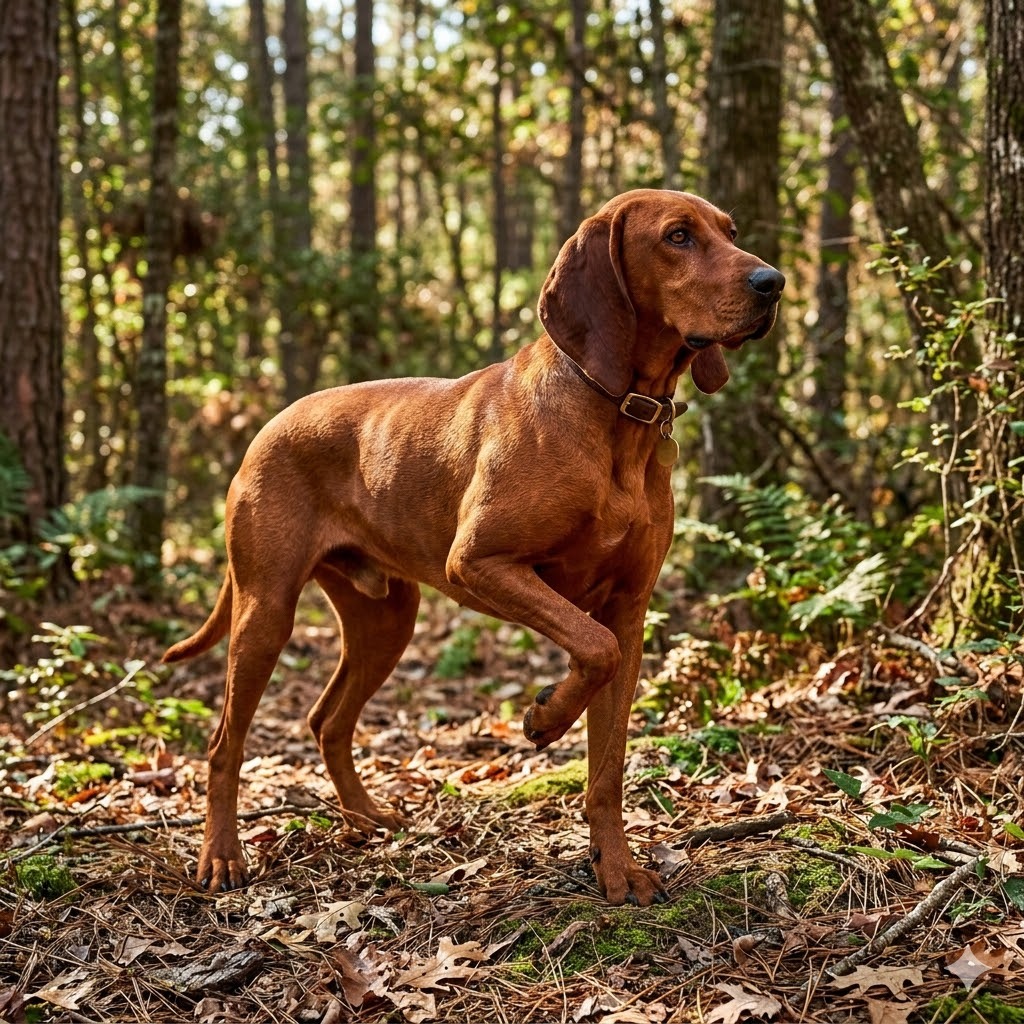
The Redbone Coonhound is a solid, handsome American scenthound clad head to toe in a rich, gleaming red coat.
🗓️ Last reviewed: July 2026
Overview
The Redbone Coonhound is a solid, handsome American scenthound clad head to toe in a rich, gleaming red coat. Bred in the southern United States to tree raccoons and trail larger game, it is an athletic, tireless hunter with a superb nose and the loud, musical, bawling bay of a working coonhound. Males stand 56-69 cm at the shoulder and weigh 20-32 kg. Off the trail the Redbone is warm, friendly, and eager to please - a more even-tempered and biddable coonhound than most - but it is still a scenthound at heart. That means a powerful, nose-driven urge to follow a scent wherever it leads, a big voice it loves to use, and a real need for daily exercise and a securely fenced yard. Give it those, and the Redbone is a genial, family-loving companion.
History & Origins
The Redbone Coonhound was developed in the American South, chiefly in Georgia, Tennessee, and the surrounding states, from red foxhounds brought over by Scottish and Irish settlers in the late 1700s and 1800s. These were later crossed with Bloodhounds and other scenthounds to sharpen the nose and trailing ability.
The breed is sometimes said to take its name from Peter Redbone, an early Tennessee breeder, though the name also simply reflects the dog's solid red colour. In the 19th century breeders worked deliberately toward a hound that was fast, hot-nosed, and could trail and tree raccoon, and also handle bigger quarry such as bear, cougar, and boar over rough southern terrain. Early Redbones often had a black saddle marking, which breeders bred out over generations to fix the clear, self-red coat that defines the breed today.
The Redbone Coonhound was recognised by the United Kennel Club in 1902 and by the AKC in 2009. It gained wider fame through the classic novel and film "Where the Red Fern Grows." Today it remains a working coon and big-game hound in rural America and an increasingly popular, good-natured family dog.
Appearance
A well-balanced, muscular, medium-large hound built for speed and endurance in rough country. Males stand 56-69 cm (22-27 in) and weigh 20-32 kg (45-70 lb); females are a little smaller. The build is athletic and streamlined, neither heavy nor racy, with a proud, alert carriage.
Key features:
- Coat: short, smooth, and coarse enough to protect against brush, sleek and glossy in good condition.
- Colour: solid, rich red - the hallmark of the breed - occasionally with a small amount of white on the chest or feet.
- Head: clean and proportionate, with a broad muzzle and a slightly houndy expression.
- Eyes: dark brown to hazel, round, with a soft, pleading hound look.
- Ears: long, fine, low-set, hanging in graceful folds close to the head.
- Body: deep chest, level back, well-muscled hindquarters for climbing and covering ground.
- Tail: medium length, carried up in a slight curve, often with a lighter "brush" at the tip.
Temperament & Character
Friendly, affectionate, and even-tempered - the Redbone is often considered one of the more mellow and biddable coonhounds. At home it is a devoted, people-loving companion that thrives on being part of the family and dislikes being isolated. It is typically good with children, patient and playful, and usually sociable with other dogs, especially those it is raised alongside.
The breed is generally friendly toward strangers rather than protective, though its deep bark makes it a fair watchdog. Redbones are eager to please and enjoy their people's company, which makes them a bit easier to live with than some of their more independent coonhound cousins.
Underneath the friendly nature runs the working scenthound. The Redbone has a strong prey drive and a nose that rules its behaviour - a bird, a squirrel, or a raccoon trail can switch it instantly from relaxed companion to single-minded tracker. And it is a loud dog: the deep, bawling, musical bay is prized in the field and can carry a long way from the back yard.
Care
Coat & Grooming
Wonderfully easy. The short red coat needs only a weekly brush with a rubber curry or hound mitt to remove loose hair and keep the shine. Redbones shed moderately year-round. Bathe every couple of months or when they roll in something, as scenthounds tend to do.
The long, low-hanging ears are the main grooming priority - they trap moisture and debris and are prone to infection, so check and clean them weekly. Trim nails regularly, brush teeth several times a week, and wipe the ears after wet or muddy outings.
Exercise & Activity Needs
High. The Redbone is a working hound with real stamina and needs a solid hour or more of vigorous daily exercise - long walks, jogging, hiking, or safe off-lead running in an enclosed space. A bored, under-exercised Redbone becomes noisy, restless, and destructive, and may take up baying or escaping to entertain itself.
Because the nose leads everything, off-lead freedom must be limited to securely fenced or genuinely safe areas. A Redbone on a hot scent will follow it for miles, deaf to recall, straight across roads and boundaries. A secure, tall fence is essential, and even then the yard should be treated as a place to burn energy, not a substitute for real exercise.
Scent games, tracking, and nose work are ideal outlets - they engage the dog's greatest talent and tire the brain as well as the body. Many Redbones also excel at competitive coonhound events and lure coursing.
Health & Lifespan
Average lifespan is 12-15 years.
Common concerns:
- Hip dysplasia - the main orthopaedic concern.
- Ear infections - very common because of the long, heavy, low-hanging ears.
- Bloat and gastric torsion (GDV) - a risk in this deep-chested breed.
- Obesity - a food-motivated hound that gains weight easily without enough exercise.
- Eye conditions such as cataracts and progressive retinal atrophy in some lines.
The Redbone is generally a robust, healthy working breed, and attentive ear care and weight control prevent most everyday problems.
Feeding & Nutrition
An active, food-motivated hound that needs good-quality nutrition to match its energy. Adults typically eat a large-breed or active formula split across two meals a day. Working or heavily exercised dogs need more; couch-bound ones need less, and it is easy to let a Redbone grow fat because it will happily eat far beyond its needs.
Because the breed is deep-chested and prone to bloat, feed two smaller meals rather than one large one, use a slow feeder if the dog gulps, and avoid hard exercise within an hour either side of eating. Keep the dog lean and muscled - you should feel the ribs easily. Fresh water always available.
Pros & Cons
Pros
- Friendly, affectionate, and even-tempered.
- One of the more trainable and biddable coonhounds.
- Striking, low-maintenance solid red coat.
- Good with children and usually with other dogs.
- Athletic and hardy, with a long lifespan.
Cons
- Loud - the deep bawling bay carries a long way.
- Strong nose and prey drive - will wander and ignore recall on a scent.
- Needs a securely fenced yard and daily hard exercise.
- Prone to ear infections and can become overweight.
- Not suited to apartments or homes that need quiet.
Best Suited For
- Active, outdoor-oriented owners and families.
- Homes with a securely fenced yard.
- People who can provide daily vigorous exercise and scent work.
- Rural or suburban settings where baying is not a problem.
Not suited for apartment dwellers, homes with close neighbours who need quiet, owners wanting reliable off-lead recall, or sedentary households.
Redbone Coonhound puppy growth chart
A typical growth curve for a large breed like the Redbone Coonhound, estimated from its adult weight of 20-32 kg. Puppies vary with sex, genetics and diet, so treat this as a guide - for your own puppy, use the puppy weight predictor.
| Age | Typical weight | % of adult |
|---|---|---|
| 2 mo | 4.4-7 kg | 22% |
| 3 mo | 6.6-10.6 kg | 33% |
| 4 mo | 8.6-13.8 kg | 43% |
| 6 mo | 12-19.2 kg | 60% |
| 9 mo | 16-25.6 kg | 80% |
| 12 mo | 18.4-29.4 kg | 92% |
| Adult | 20-32 kg | 100% |
Redbone Coonhound - frequently asked questions
Are Redbone Coonhounds loud?
Yes. Like all coonhounds they have a deep, bawling, musical bay bred to carry across the woods, and they enjoy using it. Training, exercise, and company reduce nuisance barking, but a quiet dog this is not.
Are Redbones good family dogs?
Very much so. They are friendly, affectionate, and even-tempered, generally excellent with children and sociable with other dogs, provided they get enough exercise and are not left alone too long.
Can a Redbone Coonhound be trusted off the lead?
Not reliably. The nose rules the breed, and a good scent will send a Redbone off for miles, deaf to recall. Off-lead freedom should be limited to securely fenced or genuinely safe areas.
Do they need a lot of exercise?
Yes. They are working scenthounds with real stamina and need an hour or more of vigorous activity daily, plus mental work such as scent games, or they become noisy and destructive.
Why does my Redbone need such a secure fence?
Because a scent trail overrides everything else. A Redbone will trail and dig or climb to escape a weak boundary, so a tall, secure fence is essential to keep it safe.
🧠 Test yourself: guess the dog
Three clues from our quiz bank, each about another of our dogs. Can you name them?
Clue 1.This small, silky-coated companion breed is the only dog native to Cuba and serves as its national dog.
It's the Havanese - read the full profile →
Clue 2.This tough, compact herder was bred to drive cattle across vast outback distances by nipping at their heels, earning it a heeler nickname.
It's the Australian Cattle Dog - read the full profile →
Clue 3.This energetic gundog earned its name from the way it 'springs' to flush game birds from cover.
It's the English Springer Spaniel - read the full profile →
💛 Adoptable Redbone Coonhounds near you
Real dogs of this breed (and close mixes) waiting in shelters and rescues right now, live from Petfinder. We have no affiliation and earn nothing - if someone catches your eye, the link goes straight to their shelter. New to adopting? Start with our adoption guide.
Widget not loading (some ad-blockers hide it)? Search directly on petfinder.com.