Siamese Algae Eater
The Siamese algae eater (Crossocheilus oblongus, sometimes sold as Crossocheilus siamensis) is a slim, torpedo-shaped freshwater fish prized as one of the few aquarium species that will genuinely eat problem algae, including the stubborn black-beard (brush) algae most fish ignore.
🗓️ Last reviewed: July 2026
Overview
The Siamese algae eater (Crossocheilus oblongus, sometimes sold as Crossocheilus siamensis) is a slim, torpedo-shaped freshwater fish prized as one of the few aquarium species that will genuinely eat problem algae, including the stubborn black-beard (brush) algae most fish ignore. Adults reach about 14-16 cm, so despite being sold as tiny juveniles they are an active, space-hungry fish rather than a small nano cleaner. Kept properly they are peaceful, tireless grazers that spend the day busily working over plants, wood and glass. Because they are practical workers rather than showpieces, they are usually bought to solve an algae problem, but a healthy group is genuinely entertaining to watch as they patrol every surface of the tank. They are best thought of as a long-term resident that grows with your aquarium, not a disposable clean-up crew, and they reward a keeper who gives them room, current and a varied diet.
Natural History
Native to the flowing streams and river basins of mainland Southeast Asia - Thailand, Malaysia, Laos and parts of the Mekong and Chao Phraya drainages. In the wild they live in fast, oxygen-rich water among rocks, roots and submerged leaf litter, scraping biofilm and algae off surfaces. This origin explains their love of current, clean water and their constant, restless activity in the aquarium. In their home waters they form loose foraging groups that move over the substrate together, and this social grazing instinct carries straight into captivity - which is why they behave far better in numbers than alone.
They are frequently confused with two look-alikes, which matters because the substitutes do not do the same job:
- Flying fox (Epalzeorhynchos kalopterus) - has a similar dark stripe but with a gold band above it, coloured fins, and it becomes territorial with age.
- Chinese algae eater (Gyrinocheilus aymonieri) - a different, larger, aggressive fish that stops eating algae as it matures and may rasp on the slime coat of other fish.
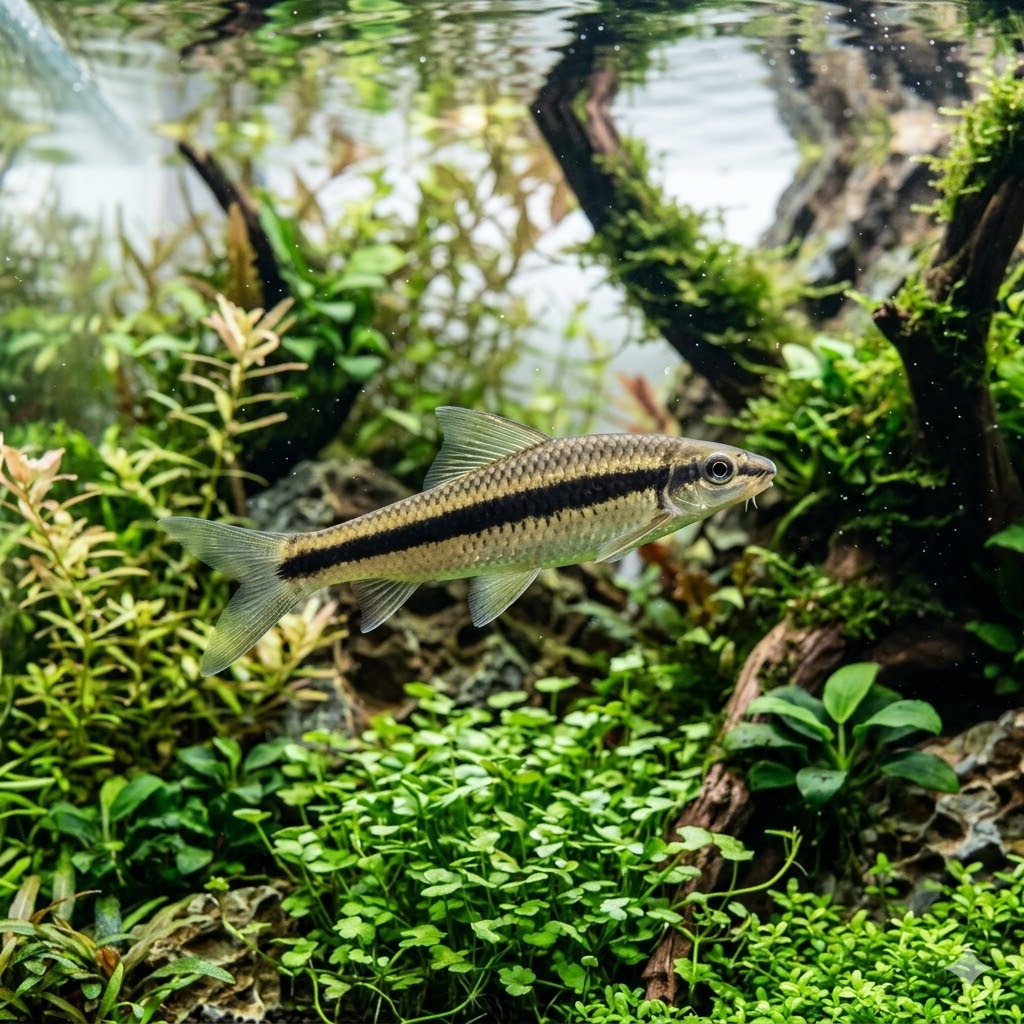
A true Siamese algae eater has a single black stripe that runs from the snout right through the tail, with a slightly ragged, zig-zag edge, clear (colourless) fins, and no barbels visible when active.
Appearance
Long, slender, silver-to-beige body with a bold black horizontal stripe running the full length from nose to tail fin. The fins are transparent and uncoloured. When stressed or resting the stripe can fade to grey. There is no bright colouration - the appeal is the clean, streamlined look and the constant grazing behaviour rather than flashy pigment.
Tank Size & Setup
Minimum tank size is around 110 litres for a small group, and larger is strongly preferred given their adult size and energy. Provide a long tank rather than a tall one - they need horizontal swimming room. Use smooth substrate, plenty of driftwood, rocks and broad-leaved plants for grazing surfaces, and a tight lid because they can jump. Good filtration and a brisk current suit their stream origins, and high oxygenation keeps them healthy. They are best kept as a small group of five or more; kept singly or in twos they can become nippy toward each other, while a group spreads out any squabbling. They are excellent members of a larger community tank of similarly sized, peaceful fish, and their activity actually encourages shyer species to come out. Just remember that the modest fish you bring home will keep growing, so plan the tank around the adult, not the juvenile in the bag.
Water Parameters
- Temperature: 24-26°C.
- pH: 6.5-7.5.
- Soft to moderately hard water.
- Ammonia 0, nitrite 0, nitrate low - they dislike dirty water.
Diet
Primarily a grazer that eats algae, including black-beard algae, plus biofilm off surfaces. In the aquarium they should not rely on algae alone. Offer quality sinking pellets, algae wafers, blanched vegetables such as courgette, spinach and cucumber, and occasional frozen or live foods like bloodworms and brine shrimp. Well-fed individuals still graze, but a hungry group is more likely to nibble delicate plants. A common mistake is to overfeed the rest of the community and leave the algae eaters so full that they stop working the tank - a light, varied supplemental diet keeps them both healthy and motivated to graze.
Health & Lifespan
Average lifespan is 8-10 years.
Hardy when kept in clean, well-oxygenated water. Common concerns:
- Stress and colour loss from poor water quality or crowding.
- Jumping injuries if the tank is uncovered.
- Ich (white spot) during temperature swings.
- Fin damage from squabbling in too-small groups.
Pros & Cons
Pros: genuinely eats problem algae including black-beard; active and hardy; peaceful in a proper group. Cons: grows large and needs space; often mis-sold as a look-alike; can nip plants or each other if underfed or under-grouped.
Siamese Algae Eater - frequently asked questions
Do they really eat black-beard algae?
Yes - true Siamese algae eaters are one of the few fish that reliably eat black-beard (brush) algae, especially when kept a little hungry.
How big do they get?
About 14-16 cm as adults - much larger than the juveniles sold in shops.
How do I tell it from a flying fox or Chinese algae eater?
Look for a single black stripe running right through the tail, a ragged edge to that stripe, and completely clear, uncoloured fins.
Can I keep just one?
It is better to keep a group of five or more, in a spacious tank, to spread out any nipping.
Are they aggressive?
Not truly aggressive, but they can be nippy toward tank-mates or each other when crowded, underfed or kept in too small a group.
🧠 Test yourself: guess the fish
Three clues from our quiz bank, each about another of our fish. Can you name them?
Clue 1.Almost all of these tiny blue-and-red beauties sold in stores are still wild-caught from blackwater rivers of South America.
It's the Cardinal Tetra - read the full profile →
Clue 2.Nicknamed the 'king of the aquarium,' this round, flat Amazonian cichlid feeds its fry on mucus from its own skin.
It's the Discus - read the full profile →
Clue 3.Males of this small, vividly colored labyrinth fish are so territorial that two cannot share a tank without fighting, giving rise to a fierce nickname.
It's the Betta (Siamese Fighting Fish) - read the full profile →