Swordtail
The swordtail (Xiphophorus hellerii) is a hardy, active livebearer named for the long sword-like extension on the lower edge of the male's tail.
🗓️ Last reviewed: July 2026
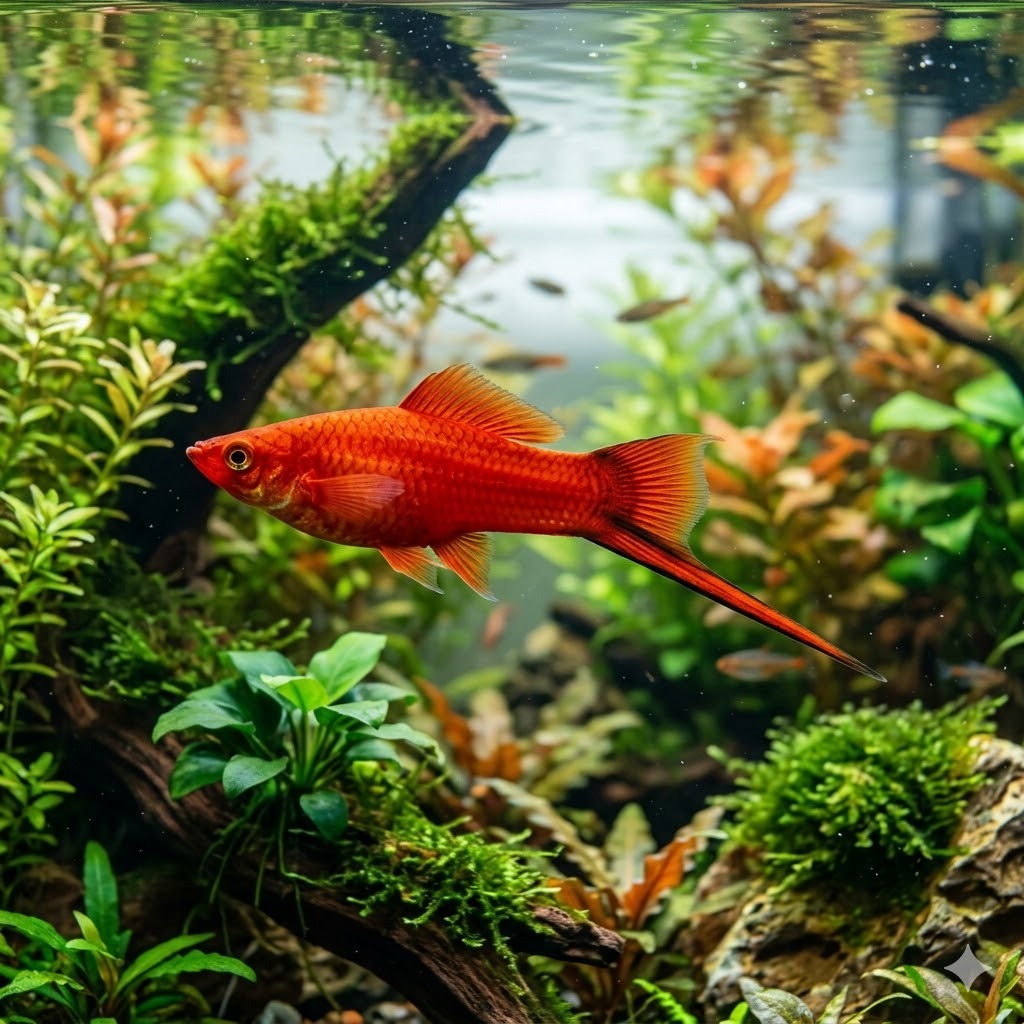
Overview
The swordtail (Xiphophorus hellerii) is a hardy, active livebearer named for the long sword-like extension on the lower edge of the male's tail. Adults reach roughly 10-14 cm including the sword (females a little shorter and swordless), and they typically live 3-5 years. Easy to keep and famously easy to breed, swordtails are a classic beginner community fish that reward a decent-sized tank with constant colour and motion.
Natural History
Swordtails are native to the fast-flowing streams, rivers, warm springs, and vegetated pools of Central America, ranging from Mexico down through Guatemala and Honduras. In the wild they occupy shallow, plant-rich, moderately flowing water and feed as opportunistic omnivores on algae, plant matter, and small invertebrates. As a livebearer, the female carries fertilised eggs internally and gives birth to free-swimming fry rather than laying eggs. Decades of aquarium breeding have produced a wide range of colours and fin types far removed from the plainer wild green form, and swordtails will readily hybridise with their close relatives, the platies (also in the genus Xiphophorus).
Appearance
The wild swordtail is olive-green with a faint red or brown lateral stripe, but captive strains come in red, orange, black, green, and multicoloured varieties, sometimes with lyretail or high-fin shapes. The defining feature is the male's "sword" - an elongated lower lobe of the tail fin that can be nearly as long as his body and is used in display. Females lack the sword, are fuller-bodied, and are usually a little larger overall. Adult males reach around 10-14 cm including the sword, while females typically measure 8-12 cm. Colour and sword length vary widely by strain.
Tank Size & Setup
Because swordtails are active, strong swimmers that appreciate horizontal room, a minimum of 80 litres is recommended, with a longer footprint preferred over a tall one. A group does best with more females than males (around two or three females per male) to spread out male attention, since males can be persistent chasers.
Provide a securely covered tank - swordtails are notorious jumpers and will leap through small gaps. Use planted areas and some open swimming space, with gentle to moderate flow that echoes their stream habitat. A well-planted tank also gives fry places to hide. Good filtration and stable, well-oxygenated water keep these energetic fish in top condition. A layer of floating plants and a background of tall stems help break the line of sight in the tank, which can calm a pushy male and give chased fish somewhere to retreat. Because swordtails are constantly on the move, they suit a display where they can be watched swimming rather than a heavily decorated tank with little open water.
Water Parameters
- Temperature: 22-28°C.
- pH: 7.0-8.2 - they prefer neutral to slightly alkaline water.
- Hardness: moderate to hard, roughly 10-25 dGH; they appreciate harder water and can benefit from a little added mineral hardness.
- Ammonia 0, nitrite 0, nitrate under 40 ppm.
Swordtails are adaptable but do best in harder, slightly alkaline water rather than the soft acidic conditions that suit many tetras.
Diet
Swordtails are omnivores with a healthy appetite and a strong appreciation for vegetable matter. Feed a quality flake or pellet as a staple, and supplement with algae-based or spirulina foods, blanched vegetables such as courgette and peas, and occasional live or frozen treats like bloodworms, daphnia, and brine shrimp. A diet with plenty of plant matter supports their digestion and keeps colours bright. Feed small amounts once or twice a day and avoid overfeeding, as these greedy fish will eat more than is good for them.
Health & Lifespan
Average lifespan is 3-5 years.
Swordtails are robust and forgiving, which is a large part of their beginner appeal, but they are not indestructible. Common concerns:
- Ich (white spot) - often stress- or chill-related.
- Fin rot and bacterial infections in poor water quality.
- Fungal infections on injured or stressed fish.
- Male aggression and chasing, which stresses subordinate males and females if the ratio is wrong.
- Constipation and bloating from overfeeding or too little vegetable matter.
Keep water stable and well-oxygenated, maintain a good female-to-male ratio, and cover the tank securely to prevent jumping accidents.
Pros & Cons
Pros: hardy and beginner-friendly, active and colourful, peaceful in a well-balanced group, easy to breed, wide variety of strains. Cons: males chase and can be pushy; strong jumpers; breed so readily that fry quickly overpopulate a tank; need a decent-sized tank and harder water; not suited to soft blackwater setups.
Swordtail - frequently asked questions
Do I need a male and female swordtail?
No, but if you keep both, expect fry - swordtails breed very readily. Keep more females than males to reduce chasing.
How can I tell males from females?
Males have the long sword extending from the lower tail and a narrow anal fin (the gonopodium); females are swordless, fuller-bodied, and often larger.
Are swordtails good for beginners?
Yes. They are hardy, adaptable, and forgiving, making them one of the best starter livebearers, provided the tank is large enough and securely covered.
Do swordtails jump?
Yes, they are well-known jumpers. Always keep the tank tightly covered with no open gaps.
What tankmates suit swordtails?
Other peaceful community fish that enjoy similar hard, neutral-to-alkaline water - platies, mollies, larger tetras, corydoras, and peaceful barbs. Avoid fin-nippers and very delicate soft-water species.
Will swordtails eat their own fry?
Yes. Adults will eat fry given the chance, so heavy planting or a separate grow-out area helps more fry survive if you want to raise them.
🧠 Test yourself: guess the fish
Three clues from our quiz bank, each about another of our fish. Can you name them?
Clue 1.This dazzling Amazonian schooling fish wears a full-length red stripe beneath its blue band, distinguishing it from a similar smaller cousin.
It's the Cardinal Tetra - read the full profile →
Clue 2.Originally from South America, this little livebearer was spread worldwide to eat mosquito larvae.
It's the Guppy - read the full profile →
Clue 3.This tiny schooling fish glows with an iridescent blue stripe and a red streak along its rear half.
It's the Neon Tetra - read the full profile →