Milk Snake
The Milk Snake (Lampropeltis triangulum) is a colourful, docile, medium-sized colubrid and a close relative of the kingsnakes.
🗓️ Last reviewed: July 2026
Overview
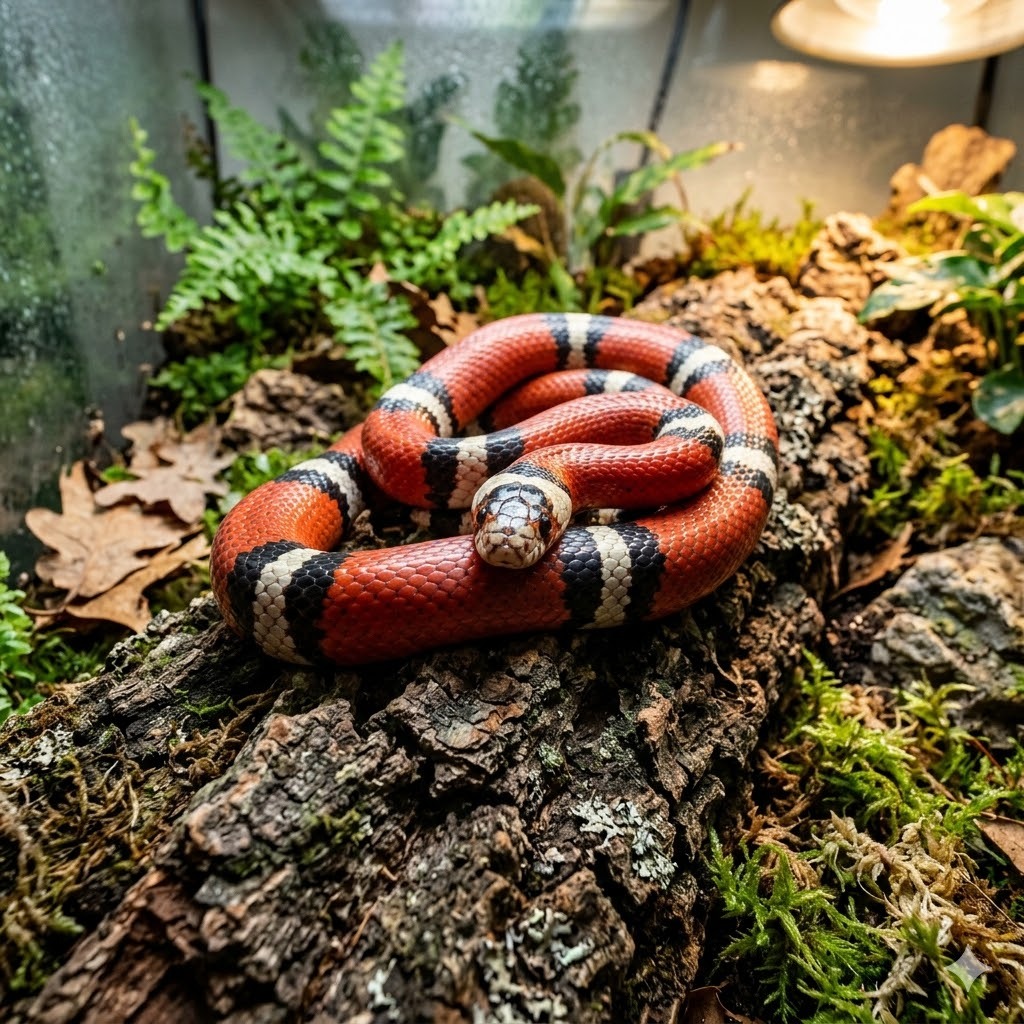
The Milk Snake (Lampropeltis triangulum) is a colourful, docile, medium-sized colubrid and a close relative of the kingsnakes. Wrapped in bold bands of red, black, and white or yellow, it is a harmless mimic of the venomous coral snake - a defence strategy known as Batesian mimicry. Milk Snakes are hardy, attractive, and generally calm once settled, making them a popular choice for keepers ready to move beyond a first snake. They are strong, active, and notorious escape artists, so a secure enclosure with a tight lid is essential. Adults typically reach 90-120 cm, though size varies widely by subspecies.
Natural History
Wild range: an enormous distribution stretching from southeastern Canada, throughout the eastern and central United States, and down through Mexico into Central America and parts of South America. This vast range has produced many subspecies that differ in size and colour, from smaller eastern forms to larger, brightly banded tropical ones such as the Honduran and Pueblan Milk Snakes popular in the hobby. Milk Snakes are secretive, largely nocturnal and crepuscular, and spend much of their time hidden under logs, rocks, and debris. The name comes from an old myth that they milked cows - untrue; they were simply found in barns hunting the rodents that gathered there.
In the wild, Milk Snakes are opportunistic hunters that eat rodents, lizards, birds, eggs, and other snakes. Their bold banding is a textbook example of Batesian mimicry: by resembling the venomous coral snake, a harmless Milk Snake gains protection from predators that have learned to avoid the coral snake's warning colours. This defence only works where the two species overlap, and the resemblance is imperfect, which is why field identification should never rely on colour rhymes. For keepers, the practical takeaways from this natural history are simple: provide plenty of hiding places to suit a secretive animal, respect the strong feeding response of a natural hunter, and remember that a snake which eats other snakes must always live alone.
Appearance
Adults commonly 90-120 cm in length, with some subspecies smaller and a few larger. Slender, muscular build. The classic pattern is alternating bands of red, black, and white or yellow, though exact colours and band widths vary by subspecies and morph. The old rhyme "red touches black, safe for Jack" reflects that most North American Milk Snakes have red bands bordered by black, distinguishing them from the coral snake they mimic - but this rule is not reliable outside the United States, so identification should never rest on rhymes alone.
Temperament & Handling
Generally docile once settled, though sometimes nervous or musky as juveniles. New or young Milk Snakes may be flighty, may release musk, or may nip when startled, but with regular gentle handling most calm down and become easy to work with. They are fast and inquisitive, so support the body fully and handle over a safe surface close to the ground in case the snake moves quickly. Bites are minor and harmless. Give a newly acquired snake a week or two to settle and start feeding reliably before beginning regular handling, and keep early sessions short and calm. Avoid handling for a day or two after feeding to prevent regurgitation, and never handle during the dull-eyed "blue" phase of shedding, when the snake sees poorly and feels vulnerable.
Enclosure
Minimum: a 90-120 cm long enclosure (roughly a 90-115 litre footprint) for an average adult; scale up for larger subspecies. Glass, PVC, or wood vivarium.
Provide:
- A very secure, tight-fitting lid. Milk Snakes are famous escape artists and will push through any gap.
- At least two hides - one on the warm side, one on the cool side.
- Substrate: aspen, cypress mulch, or coconut fibre for burrowing.
- Sturdy branches and cork for enrichment.
- A water bowl large enough to drink from and soak in.
Heating & Lighting
- Warm side / basking zone: 28-30°C.
- Cool side: 22-24°C.
- Night: can drop to 20-22°C.
- UVB: not strictly required but low-level UVB (5-6%) supports overall health and natural behaviour.
Use an overhead heat source and a thermostat; provide a clear warm-to-cool gradient so the snake can regulate its own temperature.
Humidity
Moderate - keep humidity around 40-60%, raising it slightly during shedding. A humid hide with damp moss or a light misting helps ensure clean, complete sheds, which should come off in a single piece. Avoid a constantly wet enclosure, which invites scale rot and respiratory problems. A large water bowl on the cool side also helps lift ambient humidity naturally, and checking after each shed for retained eye caps is a good routine.
Diet
Carnivorous - a rodent feeder. Milk Snakes eat whole prey:
- Staple: appropriately sized rodents (pinky through adult mice, or small rats for larger snakes).
- Prey size: roughly the width of the snake at its widest point.
- Feed thawed frozen rodents rather than live prey, which can injure the snake.
Hatchlings eat every 5-7 days; adults every 7-14 days. Milk Snakes are opportunistic and, like their kingsnake relatives, will eat other snakes in the wild - so never house them together, even briefly. A snake that refuses food is usually reacting to stress, wrong temperatures, an upcoming shed, or being disturbed too soon after arriving; correcting husbandry almost always restores a healthy appetite.
Health & Lifespan
15-20 years with good care.
Common concerns:
- Respiratory infections from cold or overly damp conditions.
- Scale rot from a wet, dirty substrate.
- Retained shed (dysecdysis) if humidity is too low, especially eye caps.
- Mites, particularly after acquiring new animals - quarantine.
- Regurgitation from handling too soon after feeding or prey that is too large.
Pros & Cons
Pros:
- Beautiful banded colours.
- Manageable size.
- Docile once settled.
- Hardy and long-lived.
- Simple, well-understood rodent diet.
Cons:
- Determined escape artist - demands a secure lid.
- Juveniles can be nervous and musky.
- Must be housed alone (eats other snakes).
- Requires whole-prey feeding.
- 15-20 year commitment.
Best Suited For
- Keepers ready for a second snake beyond the absolute basics.
- Owners who appreciate colourful, active colubrids.
- Anyone who can guarantee a truly escape-proof enclosure.
Not suited for owners uncomfortable feeding whole rodents, or those who cannot secure the enclosure fully.
Milk Snake - frequently asked questions
Is a Milk Snake venomous?
No. It is completely harmless. Its bright banding mimics the venomous coral snake as a defence, but the Milk Snake has no venom.
Are they good escape artists?
Yes - notoriously. A tight-fitting, secure lid is non-negotiable, as they will exploit the smallest gap.
How long do they live?
15-20 years with proper care.
Can I keep two together?
No. Like kingsnakes, Milk Snakes may eat other snakes. Always house them individually.
Do they bite?
Rarely, and harmlessly. Nervous juveniles may nip or musk but usually calm with gentle, regular handling.
🧠 Test yourself: guess the reptile
Three clues from our quiz bank, each about another of our reptiles. Can you name them?
Clue 1.Released pets of this freshwater turtle have made it one of the world's 100 worst invasive species.
It's the Red-Eared Slider Turtle - read the full profile →
Clue 2.A calm, easily tamed reptile that basks under heat lamps, it is one of the most beginner-friendly lizards kept as a pet.
It's the Bearded Dragon - read the full profile →
Clue 3.This spotted desert lizard is a top beginner reptile and, unusually for geckos, has movable eyelids.
It's the Leopard Gecko - read the full profile →