Senegal Parrot (Poicephalus senegalus)
The Senegal Parrot (Poicephalus senegalus) is a small, stocky African parrot and one of the calmer, quieter members of the parrot family.
🗓️ Last reviewed: June 2026
Overview
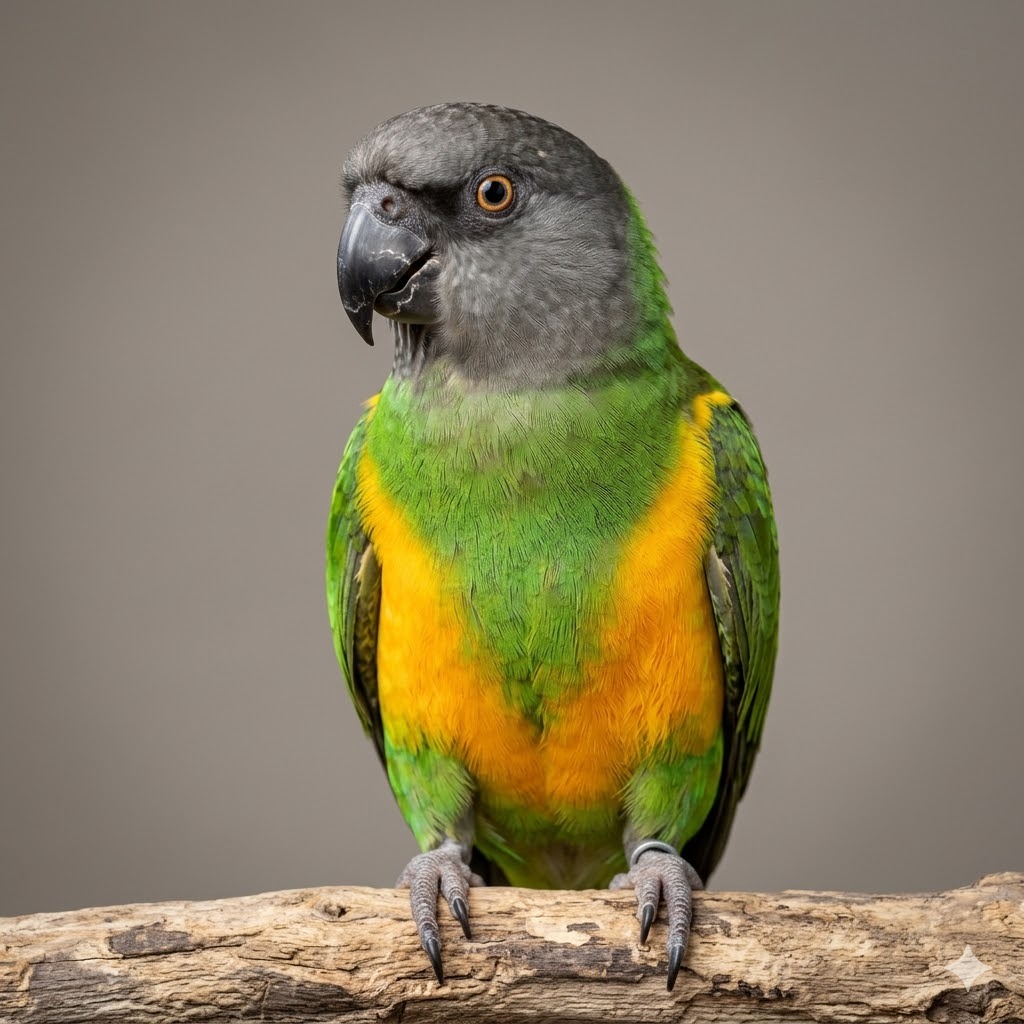
The Senegal Parrot (Poicephalus senegalus) is a small, stocky African parrot and one of the calmer, quieter members of the parrot family. With a green body, a charcoal-grey head, and a bright yellow-orange "vest" across the belly, it has the intelligence and personality of a parrot without the volume of larger species, which makes it one of the more apartment-friendly parrots to keep. It is a clever, characterful bird that can learn a few words and tricks, but it tends to bond strongly to one person and needs steady socialising to stay friendly with the whole household.
Natural History & Origin
Senegal parrots are native to West and Central Africa, where they range across open woodland and savanna from Senegal eastward. They are part of the Poicephalus genus, a group of medium-small African parrots. In the wild they forage for seeds, fruit, and blossoms, often in pairs or small flocks. They have been kept in aviculture for decades and are widely captive-bred, which is the only responsible source for a pet bird.
Appearance
Adults weigh around 120-170 g, length around 23 cm.
Colour: a green body and wings, a dark charcoal-grey head, and a distinctive yellow-to-orange "V" or vest across the chest and belly. The eye is a pale yellow in mature birds. The sexes look very similar, so reliable sexing usually needs a DNA or vet check rather than appearance alone.
Temperament & Noise
Calm, clever, and comparatively quiet. Senegal parrots are one of the less noisy parrots - they chatter, whistle, and can mimic a few words, but they lack the piercing, sustained screaming of larger parrots, which is a big part of their appeal for closer-quarters living. They are playful and curious, with a confident character in a small package.
They tend to bond very strongly to one person. Without regular, gentle handling from everyone in the home, a Senegal can become a "one-person bird" and may turn nippy or territorial toward others, particularly around its cage or its favourite person. Early and ongoing socialisation keeps them well-rounded.
Housing & Flight
Minimum cage: a roomy cage of at least about 60 x 50 x 70 cm for a single bird, and bigger is always better - they are active and need space to climb and stretch their wings. Bar spacing of about 1.5-2 cm is appropriate so the bird cannot get its head stuck.
Provide:
- Sturdy perches of varying diameter, plus chewable wood and foraging toys to occupy a clever, busy mind.
- Daily out-of-cage time in a safe, supervised, bird-proofed room - cage time alone is not enough.
- A varied rotation of toys, as bored Senegals can develop feather-plucking or screaming.
- A calm, draft-free location out of the kitchen, away from fumes.
Diet
- A quality pelleted diet as the base, which avoids the nutritional gaps of an all-seed diet.
- Daily fresh vegetables and some fruit - leafy greens, peppers, carrots, and similar in small pieces.
- A modest amount of seed or nuts as a treat or training reward, not the main food.
- A cuttlebone or mineral block for calcium.
- Fresh water daily.
Avoid: avocado (toxic to all birds), chocolate, caffeine, alcohol, onion, salt, and fruit pits or apple seeds.
Health & Lifespan
25-30 years (sometimes longer with excellent care) - a genuinely long commitment for a small parrot.
Common concerns:
- Feather-plucking and self-mutilation - often linked to boredom, stress, or too little interaction.
- Aspergillosis and other respiratory infections - parrots are sensitive to fumes (non-stick cookware, aerosols, smoke).
- Psittacosis (parrot fever) - a bacterial infection that can also affect people.
- Obesity and fatty liver disease - usually from a seed-heavy, low-vegetable diet.
- Beak and feather disease (PBFD) - a viral concern in psittacines.
- Nutritional deficiencies from an all-seed diet.
Find an avian or exotics vet experienced with parrots before acquisition, and arrange regular check-ups. Nothing here replaces professional veterinary advice.
Training & Enrichment
Senegals are clever and can learn step-up, recall, simple tricks, and a handful of words with patient, reward-based training using small food treats. Short, positive sessions work best. Enrichment is essential: foraging toys, puzzles that hide treats, fresh chewable wood, and rotating novelty all keep that busy mind occupied. A bored Senegal is far more likely to scream or pluck, so daily engagement is part of the care, not an extra.
Pros & Cons
Pros:
- Quieter than most parrots - more apartment-friendly.
- Small, hardy, and full of personality.
- Intelligent, playful, and trainable.
- Can be a devoted, affectionate companion.
Cons:
- Bonds to one person and can get nippy or territorial.
- Needs daily out-of-cage time and interaction.
- Long 25-30 year commitment.
- Can pluck or scream if bored or under-socialised.
Best Suited For
- Keepers wanting parrot personality with less noise.
- Owners able to give daily handling and enrichment.
- People ready for a multi-decade commitment.
Not suited for households with non-stick cookware in active use (fumes can kill birds quickly), smokers in the same room, anyone away from home most of the day, or first-time owners unwilling to do daily socialising and bird-proofing.
Senegal Parrot (Poicephalus senegalus) - frequently asked questions
Are Senegal parrots loud?
They are among the quieter parrots. They chatter, whistle, and mimic a little, but they lack the sustained loud screaming of larger parrots, which is why they suit closer-quarters living better than most.
Do they talk?
Some learn a few words and sounds, but they are valued more for personality than for talking. Talking ability varies a lot between individual birds and is never guaranteed.
How long do they live?
Typically 25-30 years, sometimes longer with excellent care - a long commitment for a small parrot.
Will it only like one person?
They are prone to bonding to one person, but regular handling and feeding by everyone in the home helps keep a Senegal friendly with the whole family.
Can they live in an apartment?
Yes, more comfortably than most parrots thanks to their lower volume - provided they get daily out-of-cage time, interaction, and enrichment.
🧠 Test yourself: guess the bird
Three clues from our quiz bank, each about another of our birds. Can you name them?
Clue 1.One brilliant orange-and-yellow species in this group is now endangered in the wild despite being common in captivity.
It's the Conure - read the full profile →
Clue 2.This green-and-gray parrot is the only one that builds large communal stick nests instead of nesting in tree holes.
It's the Quaker (Monk) Parakeet - read the full profile →
Clue 3.This small grey Australian parrot, the smallest member of its crested family, sports orange cheek patches and a jaunty head crest.
It's the Cockatiel - read the full profile →
Social Needs
Senegal parrots are intelligent, social birds that need daily interaction and mental stimulation from their people. A single, well-socialised Senegal can be a devoted companion, but only if the household invests real time every day - they are not a bird to be left alone in a cage.
Because they bond intensely to one person, it helps when several family members handle and feed the bird regularly so it stays comfortable with everyone. They can be kept with another bird, but housing is best approached carefully, as a strongly bonded pair may become less interested in their human family.