Star Finch
The star finch is a small, peaceful Australian finch prized for its soft colours and the delicate scatter of white "star" spots across its face and chest that give it its name.
🗓️ Last reviewed: July 2026
Overview
The star finch is a small, peaceful Australian finch prized for its soft colours and the delicate scatter of white "star" spots across its face and chest that give it its name. Gentle, quiet, and undemanding, it is a classic aviary and cage finch - a bird kept for the pleasure of watching a lively little group rather than for handling or talking. Star finches are hardy, easy-going, and among the more straightforward Australian finches to keep and breed, making them a lovely choice for finch enthusiasts and for anyone who wants beautiful, low-noise birds. Kept in a small flock with good flight space, they are active, charming, and rewarding to observe. Their gentle temperament and soft colouring make them a peaceful presence in any bird room, and a group busily working through seeding grasses is a genuinely calming sight. Because they are hardy and forgiving of small mistakes, star finches are often recommended as a first Australian finch for keepers moving up from more basic species.
Natural History & Origin
The star finch (Neochmia ruficauda) is native to northern and eastern Australia, where it lives near water in grassy country, reed beds, and the margins of swamps and rivers. Wild birds forage in small flocks for grass seeds and glean insects, especially when feeding young. Long established in aviculture, the star finch has been bred in captivity for many generations and is now far more common in aviaries around the world than some of its wild populations are in the field. Several colour varieties have been developed by breeders alongside the natural form.
Appearance
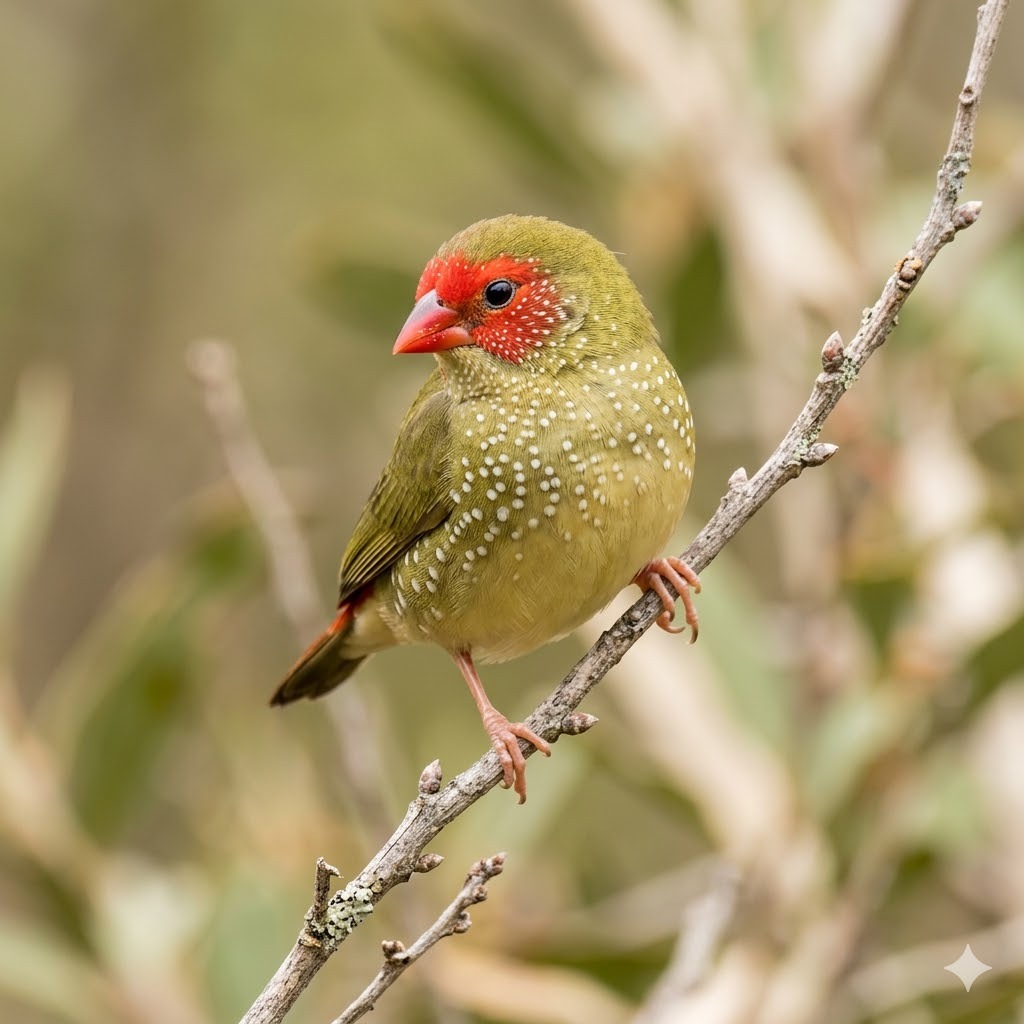
A small finch: length about 10-12 cm and weight around 10-13 g. The natural colouring is a warm olive-green above, softening to a pale yellowish belly, with a red face and red-orange beak. Scattered across the face, throat, and upper breast are numerous small white spots - the "stars" that give the bird its name. The rump and tail show reddish tones. Males are typically brighter, with a larger and more extensive red facial mask, while females are a touch duller with a smaller red area. Selectively bred varieties include yellow-faced and lighter-bodied forms.
Temperament & Noise
Star finches are calm, gentle, and sociable, getting along peacefully with their own kind and with other small, non-aggressive finches. They are quiet birds - the male's song is a soft, pleasant series of notes rather than a loud call, and the general sound of a group is a gentle chirping that will not disturb a household. They are not hands-on pets: like most finches they prefer not to be handled and are enjoyed as active, decorative aviary birds. Their peaceful nature makes them excellent community-aviary residents.
Housing & Flight
Finches need horizontal flight space far more than height. Minimum cage: a roomy flight cage around 80-100 cm long for a pair or small group, and larger is always better; a planted aviary is ideal. Bar spacing should be narrow, around 1 cm, so the small birds cannot slip through or trap their heads.
Provide:
- Several perches, including natural branches and fine twigs.
- Plenty of open flying space between perches.
- A shallow bath dish - finches love to bathe.
- Grasses, seeding heads, or greenery for foraging and cover.
- Nesting material and a nest box or wicker nest if breeding.
Diet
- A good-quality small-seed finch mix as the dietary base - mixed millets and canary seed.
- Live food such as small mealworms or fruit-fly cultures, especially important when raising young.
- Fresh greens and seeding grasses - spray millet, chickweed, soaked or sprouted seed.
- Egg food during breeding for extra protein.
- Cuttlebone, grit, and a mineral or shell source for calcium and digestion.
- Fresh water daily for drinking and bathing.
Avoid: avocado (toxic to all birds), chocolate, caffeine, alcohol, and salty or processed foods.
Health & Lifespan
Star finches typically live around 5-8 years with good care. They are hardy and generally healthy when kept warm, clean, and well fed.
Common concerns:
- Air-sac mites - a notable problem in some finch species, causing wheezing and laboured breathing.
- Intestinal parasites and worms, especially in aviary birds.
- Egg binding in breeding females lacking calcium.
- Chills and respiratory illness from cold, damp, drafty conditions.
- Scaly leg or mites if hygiene is poor.
- Stress from overcrowding or aggressive cage-mates.
Have an avian vet available, as small finches can decline quickly if unwell.
Training & Enrichment
Finches are not trained in the way parrots are - they are not handled or taught tricks. Enrichment for star finches means a stimulating environment: varied perching, growing grasses and seeding heads, regular bathing water, live food to hunt, and the company of their own kind. A planted aviary with natural foraging opportunities keeps them active, healthy, and displaying natural behaviour.
Pros & Cons
Pros:
- Beautiful soft colours with distinctive white star-spots.
- Quiet - a gentle song and chirping, no loud calls.
- Peaceful and easy to mix in a community aviary.
- Hardy and among the easier Australian finches to keep.
- A relatively straightforward breeder.
Cons:
- Not a hands-on or handleable pet.
- Must be kept in pairs or groups.
- Needs flight space and ideally an aviary.
- Susceptible to air-sac mites and chills.
- Small and delicate - can decline quickly if unwell.
Best Suited For
- Finch enthusiasts and aviary keepers.
- People wanting beautiful, quiet, low-maintenance birds to watch.
- Community aviaries with other gentle finches.
- Beginners to finch-keeping wanting a hardy, forgiving species.
Not suited for people wanting a bird to handle or train, keeping only a single bird, or cold, damp, drafty housing.
Star Finch - frequently asked questions
Why is it called a star finch?
For the scattering of small white spots across its face and breast, which look like tiny stars.
Are star finches noisy?
No - they are quiet, with a soft pleasant song and gentle chirping that will not disturb a home.
Can I keep just one?
No. They are flock birds and should be kept at least as a pair, ideally in a small group.
How long do they live?
Around 5-8 years with good care.
Are they good for beginners?
Yes - they are among the hardier and easier Australian finches, well suited to newer finch keepers.
🧠 Test yourself: guess the bird
Three clues from our quiz bank, each about another of our birds. Can you name them?
Clue 1.This loose group of small-to-medium New World parrots, often green or sun-yellow, is famous for being especially loud for its size.
It's the Conure - read the full profile →
Clue 2.These small seed-eating songbirds, such as the zebra and society varieties, are kept for their cheerful chirping rather than handling.
It's the Finch (Zebra & Society) - read the full profile →
Clue 3.Among the tiniest parrots kept as pets, this short-tailed bird is bold and feisty despite its affectionate name.
It's the Lovebird - read the full profile →
Social Needs
Star finches are flock birds and should never be kept singly. They do best as a pair or in a small group, and they mix well in a community aviary with other gentle finches such as other Australian grassfinches. They are peaceful and rarely aggressive, though during breeding they appreciate space and their own nesting spot. Watching a small colony interact is the whole point of keeping them. Provided each pair has enough space and its own nesting spot, star finches generally live together without serious squabbling, and their calm nature rarely disrupts the other residents of a mixed collection. A single bird kept alone will be stressed and withdrawn, so companionship of its own kind is not optional but essential to its wellbeing.