White Cloud Mountain Minnow
The white cloud mountain minnow (Tanichthys albonubes) is a tiny, hardy, cool-water schooling fish that is one of the best choices for a first aquarium.
🗓️ Last reviewed: July 2026
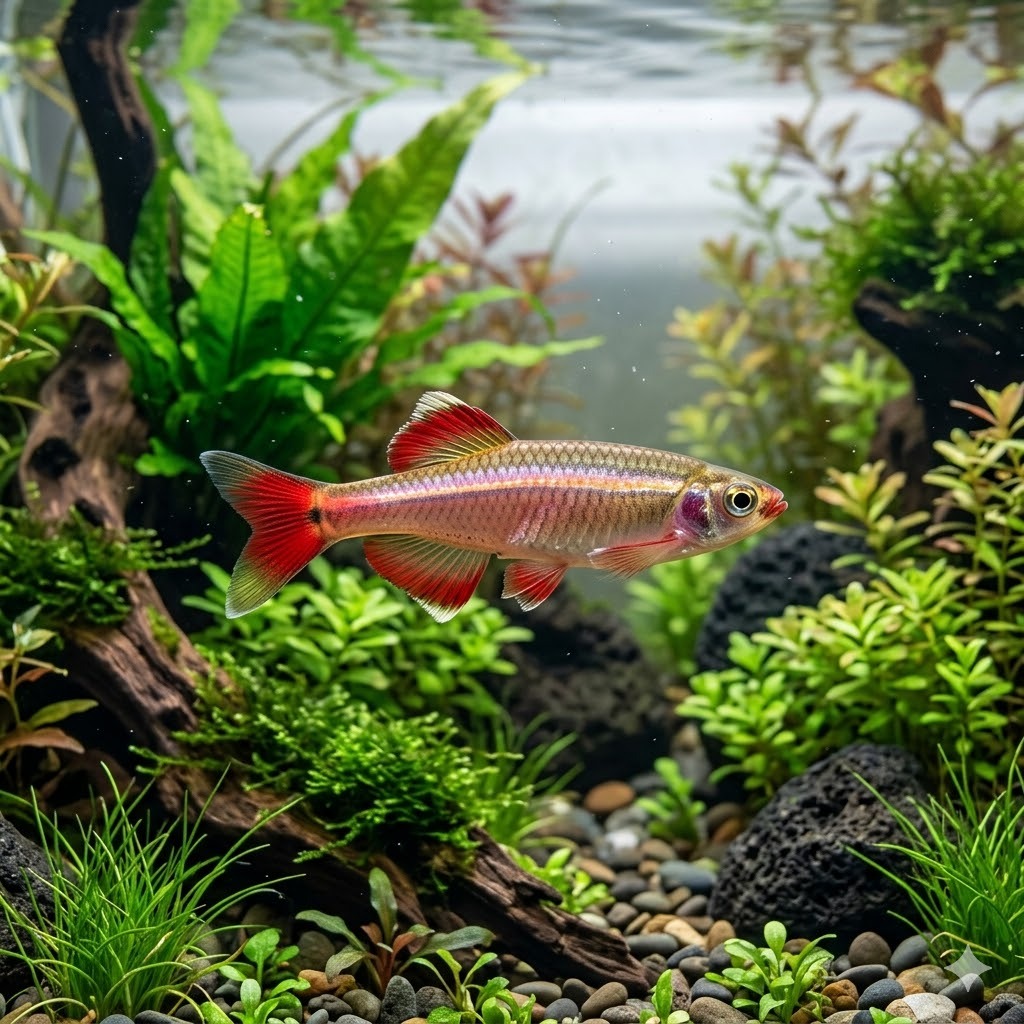
Overview
The white cloud mountain minnow (Tanichthys albonubes) is a tiny, hardy, cool-water schooling fish that is one of the best choices for a first aquarium. Adults reach only about 4 cm, and they are famous for tolerating cooler, unheated rooms that would leave tropical fish shivering. Peaceful, colourful in a subtle way and endlessly active when kept in a group, they are ideal for a nano tank or an unheated coldwater setup. They are forgiving of the small mistakes new keepers inevitably make, they breed readily without special effort, and they cost very little to keep, which together make them a superb gateway species for anyone unsure whether the hobby is for them. Watching a shoal weave through plants in the morning light is a genuine pleasure that belies how humble and inexpensive these fish are.
Natural History
Originally native to the White Cloud Mountain region near Guangzhou in southern China, where they lived in cool, clear, gently flowing hill streams. Wild populations became scarce, but the species has been bred in the aquarium hobby for decades and is now widely available. Their mountain-stream origin is the key to their care - they prefer cooler water and thrive in temperatures that many tropical fish cannot handle.
They are sometimes nicknamed the "poor man's neon tetra" for their bright lateral stripe, though they are unrelated to tetras. Several colour forms exist, including a golden variety and a long-finned "meteor minnow" form. Their remarkable cold tolerance is a direct legacy of those upland streams, where seasonal temperatures fall well below what a tropical species could survive, and it is what allows a keeper today to run a healthy, planted tank with no heater at all.
Appearance
Small and slim, with an olive-brown to greenish back and a shimmering horizontal stripe of pinkish-gold to iridescent green running along each side, ending in a red spot at the base of the tail. The fins are tinged with red and yellow, most vivid in males during display. Colour intensifies dramatically when a group is kept in cooler water and in a well-planted, darker-substrate tank. Males are generally slimmer and more brightly coloured, and they display to one another by flaring their fins and squaring up in harmless contests that are one of the delights of keeping a full shoal. Females are a touch rounder and plainer, especially when carrying eggs.
Tank Size & Setup
Minimum tank size is around 40 litres for a good-sized school, though bigger is always better for swimming room. Provide a longer tank with gentle to moderate flow, fine substrate, live plants and some open water for schooling. A tight-fitting lid is wise as they are lively. Crucially they are a schooling species and should be kept in a group of at least 8, ideally more - a proper school brings out their colour, natural behaviour and confidence. They often do not need a heater at all in a normally heated home, which makes them one of the few true coldwater nano fish. A gentle sponge filter suits both the fish and their fry, and a background of dense planting with a darker substrate makes their colours pop while giving any young fish somewhere to hide. Because they enjoy oxygen-rich water, a little surface movement is welcome even though they do not need strong current.
Water Parameters
- Temperature: 16-22°C - cooler than tropical fish; can tolerate brief dips lower.
- pH: 6.0-8.0.
- Soft to moderately hard water.
- Ammonia 0, nitrite 0, nitrate low.
Diet
Easy-going omnivore. They accept quality micro-pellets and crushed flake, and relish small live and frozen foods such as daphnia, baby brine shrimp and micro-worms. A varied diet keeps colours bright and supports spawning. Being small-mouthed, food should be appropriately sized. They are keen, non-fussy eaters, which is part of what makes them so easy for beginners, but their small size means little and often works better than a single large feeding, and any uneaten food should be removed to keep the water pristine.
Health & Lifespan
Average lifespan is 5-7 years.
Exceptionally hardy and disease-resistant when water is kept clean. Common concerns:
- Overheating - they do worse in warm tropical tanks over long periods.
- Ich (white spot) during temperature swings.
- Fin nipping stress if kept in too small a group.
- Fin rot in dirty water.
Pros & Cons
Pros: extremely hardy and beginner-friendly; peaceful; thrives unheated as a true coldwater nano fish; colourful in a group; breeds easily and cheaply. Cons: small and easily overlooked singly; needs a decent-sized school to shine; not suited to warm tropical community tanks long-term; colours are muted outside a proper group.
White Cloud Mountain Minnow - frequently asked questions
Do they need a heater?
Usually not - they thrive at normal room temperatures and prefer cooler water, making them one of the few true unheated nano fish.
How many should I keep?
At least 8, and more is better. They are a schooling fish and only look and behave their best in a group.
How big do they get?
About 4 cm - a genuinely tiny fish suited to nano tanks.
Can they live with goldfish?
Small goldfish may cohabit briefly, but adult goldfish will eventually eat them, so it is not a reliable long-term mix.
Are they good for beginners?
Yes - they are among the hardiest, most forgiving aquarium fish available.
🧠 Test yourself: guess the fish
Three clues from our quiz bank, each about another of our fish. Can you name them?
Clue 1.Often confused with a deeper-red cousin, this small fish has red only on its back half, not its whole belly.
It's the Neon Tetra - read the full profile →
Clue 2.Diamond-shaped with long flowing dorsal and anal fins, this popular tank fish needs a tall aquarium to accommodate its towering body.
It's the Angelfish - read the full profile →
Clue 3.Domesticated from a dull carp over a thousand years ago in China, this orange fish is one of the oldest kept pets.
It's the Goldfish - read the full profile →