Painted Turtle
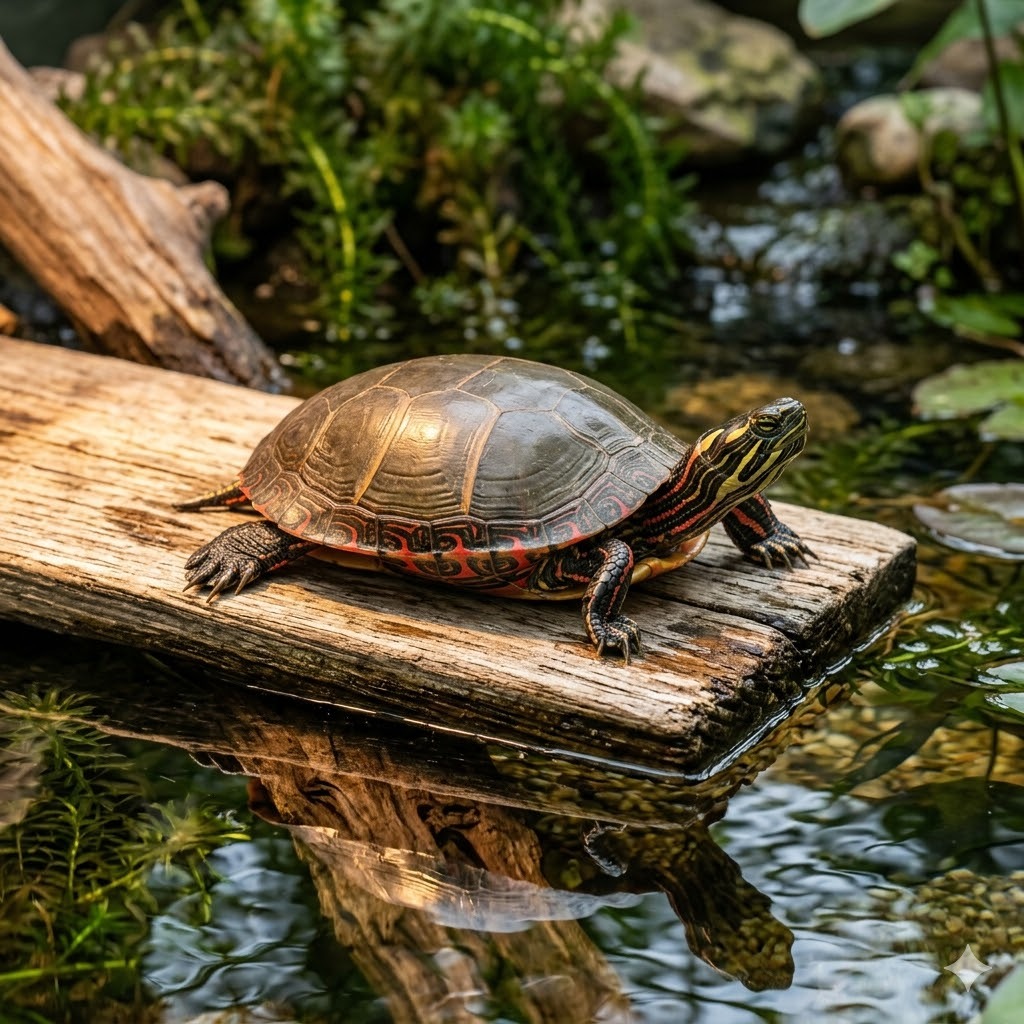
The Painted Turtle (Chrysemys picta) is a hardy, brightly marked aquatic turtle that spends its days swimming and basking.
🗓️ Last reviewed: July 2026
Overview
The Painted Turtle (Chrysemys picta) is a hardy, brightly marked aquatic turtle that spends its days swimming and basking. One of North America's most common and adaptable turtles, it is tough and long-lived, but it is not a low-effort pet. Painted turtles need a large filtered tank or pond, strong UVB, and a dry basking dock, and because they are messy eaters they demand heavy filtration and regular water changes. With the right setup they are rewarding, active display animals - and, as with all turtles, careful hygiene is important because of salmonella.
Natural History
Wild range: across much of North America, from southern Canada through the United States, in slow-moving fresh water - ponds, marshes, lakes, and quiet river edges with soft bottoms and plenty of vegetation. Painted turtles are strong swimmers that spend much of the day basking on logs and rocks to warm up, then return to the water to feed and rest. In cold regions they overwinter at the bottom of ponds. They are diurnal, alert, and quick to slip into the water when startled.
Appearance
Adults 12-25 cm shell length, with females usually larger than males.
The smooth, low carapace is dark olive to black, often edged with red markings, while the skin is dark with striking yellow and red stripes on the head, neck, and legs - the "painted" look that gives the species its name. The plastron is yellow, sometimes patterned. Their bright markings and smooth shell make them one of the more attractive native turtles.
Temperament & Handling
Active and alert, but not a handling pet. Painted turtles are best enjoyed as a swimming, basking display animal rather than something to hold. They can be skittish and may dive for cover when approached, though many learn to associate their keeper with food. Handle only when necessary - to move or health-check them - supporting the body and expecting some wriggling. Frequent handling stresses them and increases the risk of transferring salmonella.
Enclosure
Large aquatic tank or outdoor pond. For one adult, aim for a tank of at least 200-300 litres, scaling up with the turtle's size - the rule of thumb is roughly 40 litres of water per centimetre of shell.
Provide:
- A deep swimming area with room to move.
- A dry basking dock or platform where the turtle can leave the water completely and dry off.
- Powerful filtration rated well above the tank volume.
- Smooth decor and, if desired, tough plants.
An outdoor pond, if secure and predator-proof, is an excellent option in suitable climates. Because these turtles foul the water quickly, over-filter and change water regularly.
The single biggest mistake new keepers make is an undersized tank with weak filtration. Painted turtles are strong, active swimmers that need real room to move, and their messy feeding quickly overwhelms a filter rated only for the tank volume. Choosing a filter designed for a much larger aquarium, combined with routine partial water changes, keeps the water clear and the turtle healthy. The dry basking dock is just as important as the water: it must be large and stable enough for the turtle to climb fully out and dry off, which is essential for shell health.
Heating & Lighting
- Water temperature: 22-26°C, maintained with an aquarium heater and guard.
- Basking spot: 30-32°C over the dry dock.
- UVB: essential and strong - a good UVB source over the basking area is critical for shell and bone health.
Use a basking bulb plus UVB on a timer above the dock, and a thermostatically controlled water heater. Without strong UVB and a proper basking spot, painted turtles develop serious shell disease. UVB bulbs lose their output over time even when they still give visible light, so they need replacing on a regular schedule rather than only when they burn out. The basking area should reach a genuinely warm temperature, since a turtle that cannot properly warm up and dry off is far more prone to shell and respiratory problems.
Humidity
Not applicable in the usual sense - this is an aquatic species whose "humidity" is its water. The priorities instead are clean, well-heated water and a genuinely dry, warm basking area so the turtle can fully dry its shell between swims, which helps prevent shell rot.
Diet
Omnivorous, shifting with age. Young turtles are more carnivorous; adults eat more plants:
- Animal foods: aquatic invertebrates, insects, and appropriate turtle-safe protein.
- Plant foods: leafy greens and aquatic plants.
- A quality commercial aquatic turtle food can form part of a balanced diet, alongside fresh items.
Offer variety and provide calcium for shell health. Feed juveniles daily and adults every 2-3 days, removing uneaten food promptly - these messy feeders quickly foul the water, which is why strong filtration matters so much.
Because painted turtles shift from a more meat-heavy diet as youngsters to a more plant-heavy one as adults, the balance of foods should change with age. Leafy greens and aquatic plants become an increasingly important part of an adult's diet, while young turtles need more protein for growth. A varied menu paired with calcium supports strong, smooth shell growth and helps prevent the deformities that come from an unbalanced diet. Some keepers feed in a separate container to keep the main tank cleaner, which can cut down on how often the water needs changing.
Health & Lifespan
15-30 years, sometimes longer with excellent care.
Common concerns:
- Shell rot and shell infections from poor water quality or an inadequate dry basking area.
- Metabolic bone disease from insufficient UVB or calcium.
- Respiratory infections from cold water or a cold basking spot.
- Vitamin A deficiency, causing swollen eyes.
- Salmonella - turtles can carry it without appearing ill, so hygiene is essential.
Pros & Cons
Pros:
- Hardy and adaptable.
- Attractive, active swimmer and basker.
- Long-lived.
- Suits a large tank or an outdoor pond.
Cons:
- Messy - needs heavy filtration and frequent water changes.
- Requires strong UVB and a proper basking dock.
- Large water volume and setup needed.
- Salmonella risk means strict hygiene.
Best Suited For
- Keepers with room for a large tank or pond.
- Owners happy to maintain water quality.
- People who enjoy watching rather than handling.
Not suited for anyone wanting a small, low-maintenance, or handling-focused pet, or who cannot commit to serious filtration and hygiene.
Painted Turtle - frequently asked questions
How big a tank do they need?
Large - at least 200-300 litres for one adult, scaling up with size, roughly 40 litres of water per centimetre of shell.
Do they need UVB?
Yes, and strong UVB - it is essential for shell and bone health, along with a proper dry basking spot.
Why is the water always dirty?
Painted turtles are messy feeders. Use filtration rated well above the tank volume, remove uneaten food, and change water regularly.
Are they safe to handle?
Handle only when necessary. Turtles can carry salmonella without looking ill, so wash hands thoroughly and keep handling to a minimum.
How long do they live?
15-30 years and sometimes longer with excellent care.
🧠 Test yourself: guess the reptile
Three clues from our quiz bank, each about another of our reptiles. Can you name them?
Clue 1.A calm, easily tamed reptile that basks under heat lamps, it is one of the most beginner-friendly lizards kept as a pet.
It's the Bearded Dragon - read the full profile →
Clue 2.A harmless rodent-eating colubrid, it is often confused with the venomous copperhead but kills prey by squeezing.
It's the Corn Snake - read the full profile →
Clue 3.This spotted desert lizard is a top beginner reptile and, unusually for geckos, has movable eyelids.
It's the Leopard Gecko - read the full profile →