Tokay Gecko
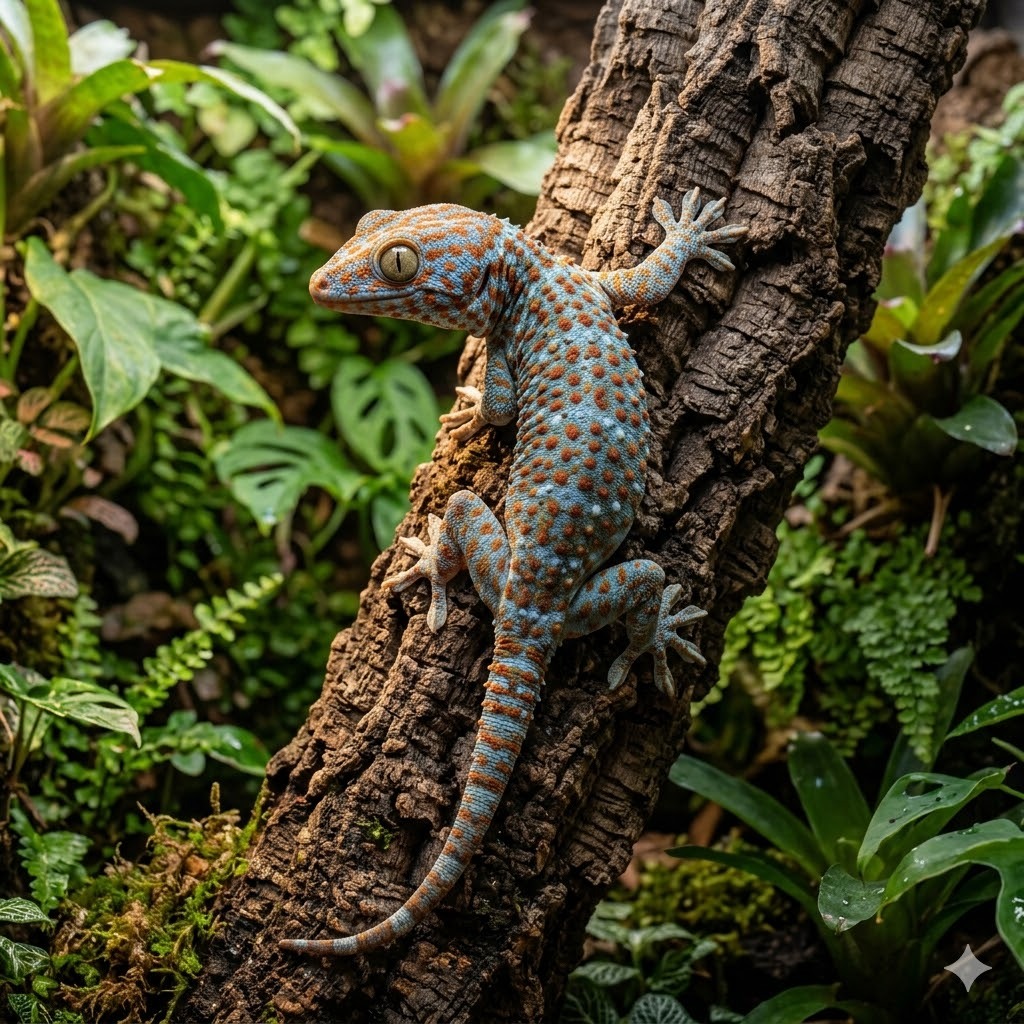
The Tokay Gecko (Gekko gecko) is one of the largest, loudest, and most striking geckos in the pet trade - a bold blue-grey lizard splashed with vivid orange and red spots.
🗓️ Last reviewed: July 2026
Overview
The Tokay Gecko (Gekko gecko) is one of the largest, loudest, and most striking geckos in the pet trade - a bold blue-grey lizard splashed with vivid orange and red spots. Native to Southeast Asia, it is famous for two things: its dazzling colours and its ferocious attitude. Reaching 25-35 cm in length, this is a big, powerful, arboreal gecko that is best kept as a display animal rather than a pet you handle. Honest keepers describe the Tokay as "look, do not touch." It is fascinating, hardy, and beautiful, but it will bite hard and hold on, and that reality should shape every decision to own one.
Natural History
Wild range: southern China, India, Bangladesh, and across mainland and island Southeast Asia (Thailand, Indonesia, the Philippines). The Tokay lives in tropical rainforest and has adapted extremely well to human structures, often living in the walls and roofs of houses where it hunts insects around lights. It is nocturnal and highly arboreal, spending its life climbing vertical surfaces on adhesive toe pads. The name "tokay" comes from its loud territorial call - a repeated "to-kay, to-kay" bark that can carry across a room and startle a whole household at night.
In parts of its range the Tokay is regarded as a lucky household guest because it eats mosquitoes, cockroaches, and other pests, and its call is sometimes considered a good omen. Unfortunately, this popularity has a dark side: huge numbers are collected from the wild each year for the pet trade and for the traditional-medicine market, which puts real pressure on wild populations. For the hobby, this makes captive-bred animals not only healthier and calmer but also the responsible choice. Understanding that the Tokay is a wild-tempered, forest-dwelling hunter - not a domesticated pet - is the key to keeping it well and setting realistic expectations.
Appearance
Adults 25-35 cm total length, with males typically larger than females. Body mass 150-300 g in large males. The base colour is a soft blue-grey, decorated with bright orange, red, and pale spots, and large golden eyes with vertical pupils. The skin has a slightly bumpy, tubercled texture. Males are more vividly coloured than females. Colour intensity shifts with mood, temperature, and lighting - a relaxed, warm gecko often shows richer blue and brighter spots, while a stressed or cold one may look dull and grey. The broad triangular head is powerful and houses the strong jaws responsible for the species' famous bite. Selective breeding has begun to produce colour morphs such as high-blue, powder-blue, and patternless lines, though wild-type animals remain the most common. The wide, padded toes and gripping tail make it a superb climber able to hang upside down from glass and smooth leaves.
Temperament & Handling
Aggressive and defensive. This is the honest headline: Tokay Geckos are among the most bite-prone reptiles commonly sold. When threatened they open their mouths wide, bark loudly, lunge, and deliver a strong, grinding bite that can break skin and hold on for minutes. This is a display species, not a handling pet. With patient long-term work some individuals settle a little, but you should assume you will not be cuddling this animal. Wild-caught adults are especially fierce; captive-bred juveniles raised with gentle exposure are somewhat calmer but still not tame. Like most geckos, the Tokay can drop its tail (autotomy) under stress, so rough handling risks losing the tail as well as getting bitten.
Enclosure
Minimum: 45 × 45 × 60 cm (taller than wide) for one adult. Bigger is better. Because Tokays are arboreal, vertical height matters more than floor space. Glass or PVC terrarium with secure, escape-proof doors.
Provide:
- Vertical cork bark, bamboo, and sturdy branches for climbing.
- Dense foliage (live or artificial) for cover and security.
- Several elevated hides and cork tubes.
- Substrate that holds humidity: coconut fibre, orchid bark, or a bioactive mix.
- Shallow water dish, plus daily misting for droplets to drink.
A hidden, secure Tokay is a calmer Tokay. Give it plenty of places to retreat.
Heating & Lighting
- Warm side / basking zone: 30-32°C.
- Ambient: 26-28°C.
- Night: 22-24°C is fine.
- UVB: low-to-moderate UVB (5-6%) is recommended for long-term health, mounted so the gecko can bask and retreat as it chooses.
Use overhead heat and a thermostat; avoid heat rocks, which cause burns.
Humidity
Tropical species - keep humidity around 60-80%. Mist once or twice daily, allowing brief drying between mistings to prevent stagnant, mouldy conditions. Good ventilation plus humidity is the balance to aim for. A digital hygrometer takes the guesswork out of this. Live plants and a bioactive substrate help hold humidity steady and create the humid microclimates the gecko needs for clean, complete shedding, particularly on the toes where retained skin can constrict and cause damage.
Diet
Insectivorous, with occasional larger prey given the Tokay's size:
- Staple: crickets, dubia roaches, locusts.
- Occasional: hornworms, silkworms, superworms.
- Large adults: an occasional pinky mouse is sometimes offered but is not required and adds fat.
- Avoid: wild-caught insects (parasites, pesticides) and fireflies (toxic).
Gut-load insects and dust with calcium plus D3 and a multivitamin on a rotating schedule. Adults eat every 2-3 days; juveniles daily or every other day. Feeding tongs keep fingers well away from that bite, and they also let you offer prey from a safe distance without stressing the gecko. A shy Tokay may refuse to feed while watched, so leaving a few insects in the enclosure overnight can help. Always remove uneaten live prey, as crickets and roaches left in the enclosure can nibble a resting or shedding gecko.
Health & Lifespan
10-20 years in captivity with good care.
Common concerns:
- Metabolic bone disease from poor calcium/D3 or no UVB.
- Respiratory infections from cold or overly wet, stagnant enclosures.
- Retained shed, especially on toes, if humidity is too low.
- Mouth rot (stomatitis).
- Internal parasites, common in wild-caught imports - captive-bred animals are strongly preferred.
- Stress and injury from over-handling, including tail loss.
Pros & Cons
Pros:
- Spectacular colours - a true showpiece.
- Hardy once established.
- Fascinating natural behaviour and vocalisations.
- Long-lived.
- Compact vertical footprint.
Cons:
- Not a handling pet - bites hard and often.
- Loud night-time calls.
- Wild-caught animals arrive stressed and parasitised.
- Needs consistent humidity and ventilation.
- 10-20 year commitment.
Best Suited For
- Experienced keepers who want a display animal.
- Hobbyists fascinated by behaviour rather than handling.
- Owners who can source captive-bred stock.
Not suited for beginners, children, or anyone wanting a reptile to hold regularly.
Tokay Gecko - frequently asked questions
Can I tame a Tokay Gecko?
Rarely fully. Some captive-bred individuals mellow with patient, low-stress exposure, but most stay defensive. Treat it as a look-do-not-touch pet.
Are they loud?
Yes. The territorial "to-kay" bark is genuinely loud and often happens at night - a real consideration for shared or small living spaces.
How long do they live?
10-20 years with good husbandry.
Do their bites hurt?
Yes. A large Tokay can break skin and hold on. Use feeding tongs and minimise handling.
Should I buy wild-caught or captive-bred?
Captive-bred, always. Wild imports are stressed, often parasitised, and even more aggressive.
🧠 Test yourself: guess the reptile
Three clues from our quiz bank, each about another of our reptiles. Can you name them?
Clue 1.Long thought extinct, this lizard has eyelash-like fringes over its eyes and cannot regrow its tail once dropped.
It's the Crested Gecko - read the full profile →
Clue 2.Native to Australia's arid interior, this omnivorous lizard flattens its body and flares spiny scales to look larger to predators.
It's the Bearded Dragon - read the full profile →
Clue 3.This stocky Australian lizard gapes its mouth to flash a startling cobalt-colored mouth-organ at predators when threatened.
It's the Blue-Tongue Skink - read the full profile →