Mexican Red Knee Tarantula
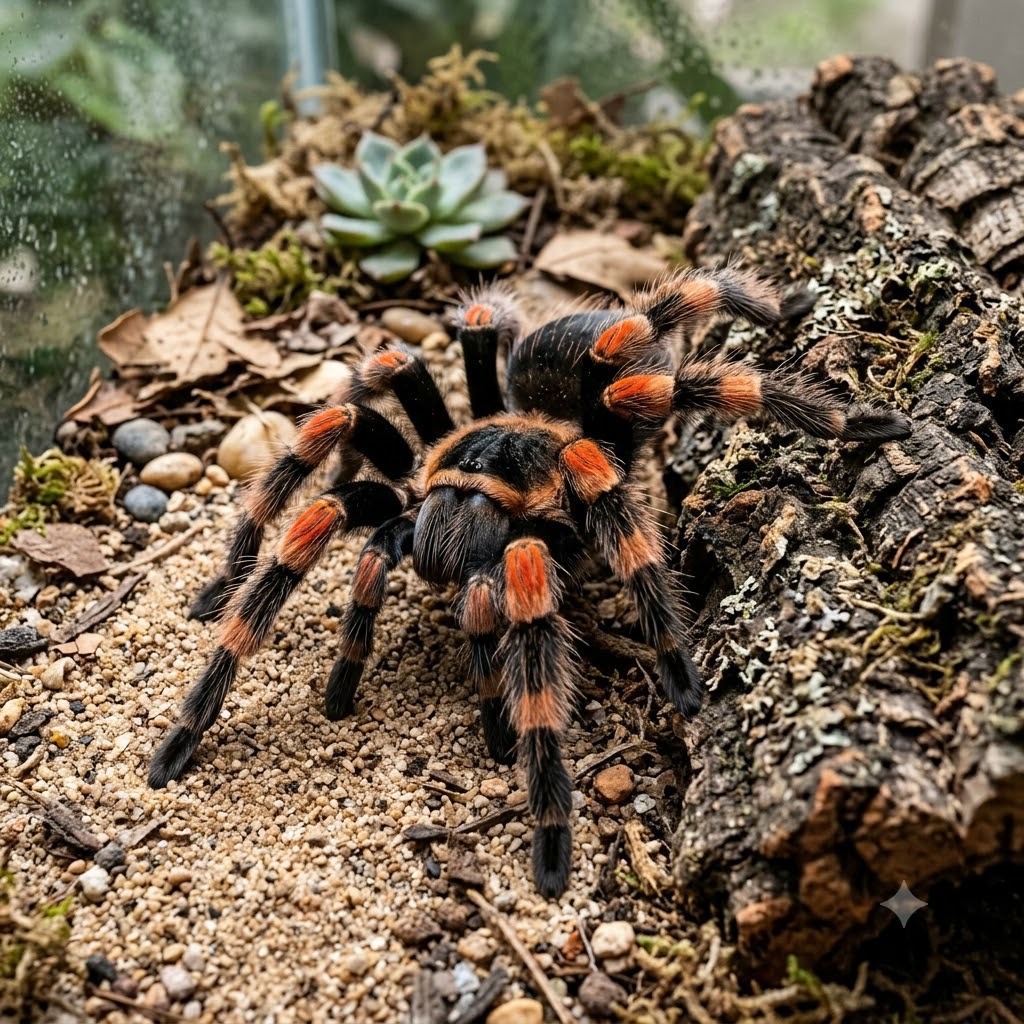
The Mexican Red Knee Tarantula is the classic beginner tarantula - a slow-moving, strikingly colored New World species famous for its orange-and-black banded legs and a calm temperament that made it the movie industry's favorite spider.
🗓️ Last reviewed: July 2026
Overview
The Mexican Red Knee Tarantula is the classic beginner tarantula - a slow-moving, strikingly colored New World species famous for its orange-and-black banded legs and a calm temperament that made it the movie industry's favorite spider. Average lifespan for females is 20-30 years, among the longest of any pet invertebrate. (Brachypelma hamorii.)
Origin & Habitat
Pacific coast of Mexico - dry scrubland and deciduous forest edges, where it digs burrows at the base of thorny vegetation.
Appearance
Legspan 13-15 cm. Jet-black body with vivid orange-red patches on the leg joints ('knees') and a pale carapace rim - one of the most recognizable spiders on Earth.
Temperament & Handling
Docile and slow, rarely defensive; it prefers to retreat rather than kick hairs or bite. Still an observation pet - falls are dangerous for heavy-bodied terrestrials, so handling is best avoided.
Enclosure
A 30 × 30 cm terrestrial setup with 8-10 cm of dry coco fibre, a cork-bark hide and a shallow water dish. Ventilation matters more than size; oversized enclosures stress the spider.
Heating, Humidity, Lighting
Room temperature 22-27°C suits it; no heat lamp needed in a normal home. Keep humidity low (50-60%) - this is a dry-scrub species; a damp corner near the dish is enough.
Diet
2-4 appropriately sized crickets or roaches weekly for juveniles; adults eat every 1-2 weeks and may fast for months before a molt - normal, not alarming. Remove uneaten prey within a day.
Health & Lifespan
Extremely hardy. The main risks are falls, wet substrate (causes stress and mycosis) and disturbed molts - never touch a spider lying on its back; that is molting, not dying. Females live 20-30 years, males 5-8.
Pros & Cons
Pros
- Iconic looks and legendary calm temperament
- Decades-long lifespan for females
- Cheap, simple, low-space care
Cons
- Kicks urticating hairs if truly stressed
- Long pre-molt fasts worry new keepers
- Males live only a fraction as long
Mexican Red Knee Tarantula - frequently asked questions
Can I handle it?
It tolerates gentle handling better than most tarantulas, but modern keeping discourages it - a fall from hand height can rupture the abdomen fatally.
Why has it stopped eating?
Almost always pre-molt. Offer food every week or two and remove it if ignored; fasting for 1-3 months before a molt is completely normal.
Is it endangered?
Wild populations are CITES-listed due to past over-collection - buy only captive-bred spiders, which are widely available.
🧠 Test yourself: guess the exotic
Three clues from our quiz bank, each about another of our exotic. Can you name them?
Clue 1.This crustacean has a soft, spiraled abdomen and must borrow an empty snail shell to protect its body.
It's the Hermit Crab - read the full profile →
Clue 2.Belonging to an order whose name means 'apparition,' this insect includes some of the longest insects on Earth.
It's the Stick Insect (Phasmid) - read the full profile →
Clue 3.This ambush hunter has a single ear on its underside, tuned to detect the echolocation of hunting bats.
It's the Praying Mantis - read the full profile →